- Best hours: roughly 10 PM to 2 AM local time, peaking near magnetic midnight, which is often a bit later than clock midnight.
- Best months: September, October, February and March. They have long nights, and the equinoxes bring more geomagnetic storms.
- Best years: the years around and just after solar maximum. 2026 and 2027 still count.
- Non-negotiables: real darkness, clear skies, and little or no moonlight. Activity alone isn't enough.
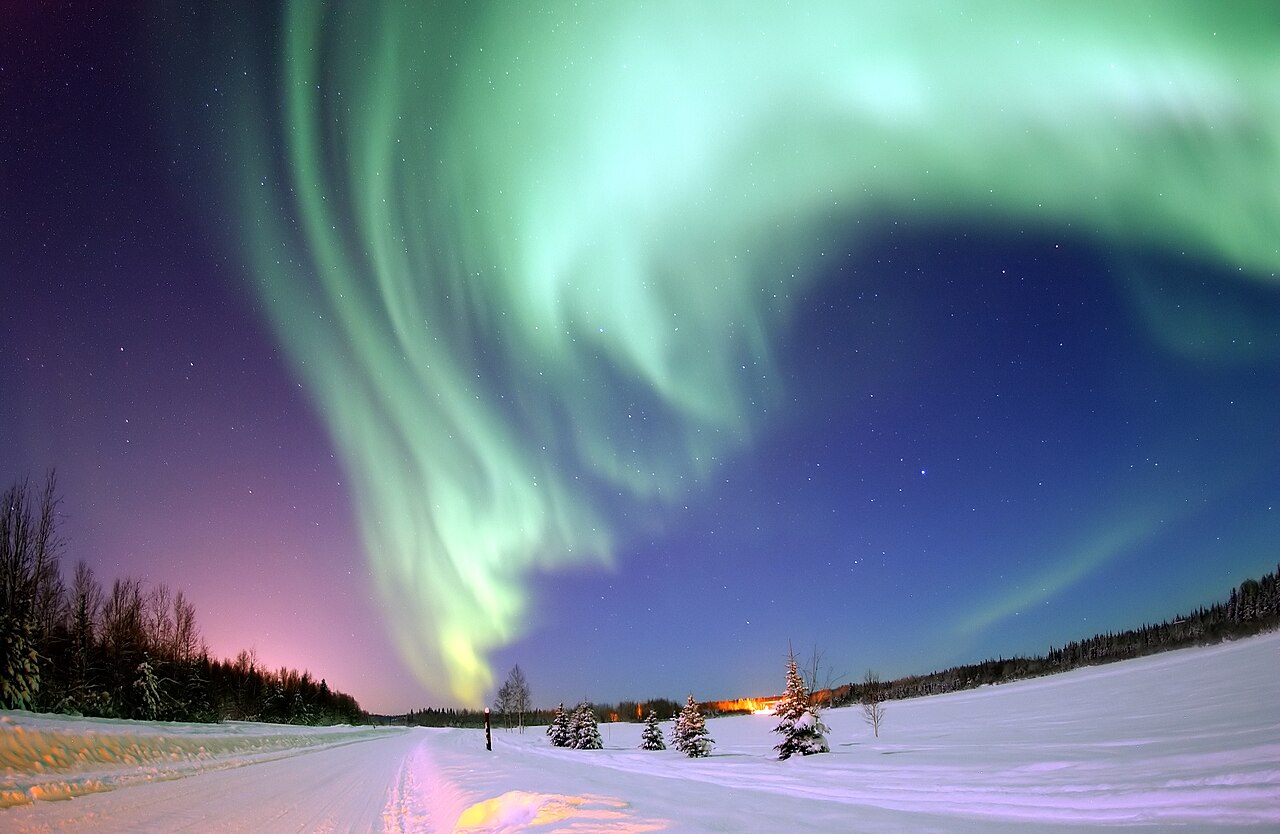
What time of night are the northern lights visible?
The short answer: between about 10 PM and 2 AM local time, with the most dramatic activity usually clustered around the middle of that window. That's not a rule of thumb borrowed from tour operators. It follows from how the aurora is arranged around the planet.
The aurora forms a ring around each magnetic pole called the auroral oval. That ring isn't uniform. It's lopsided: thinner and dimmer on the sun-facing (day) side, and wider, brighter and pushed farther toward the equator on the night side. As Earth rotates, you're carried underneath that ring once a day. You pass beneath its most active stretch in the hours around local midnight, when you face directly away from the sun, down the length of Earth's magnetic tail.
That tail is where the energy for the biggest displays builds up and then suddenly releases in events called substorms (we walk through the full chain in what actually causes the northern lights). Substorms can happen at any hour, but you're best placed to see them when you're on the midnight side of the planet.
How a typical aurora night unfolds
| Local time | What you're likely to see |
|---|---|
| Dusk – 10 PM | Quiet, steady arcs low on the northern horizon (southern, in the southern hemisphere). Often faint and greyish to the eye. |
| 10 PM – 2 AM | The main event. Arcs brighten, fold into curtains and spirals, and may burst overhead in a substorm "breakup" lasting 10–30 minutes. |
| 2 AM – dawn | Patchy, diffuse glow and pulsating aurora that blinks on and off every few seconds. Easy to miss, but worth photographing. |
A typical pattern on an active night. Strong storms can break it at any point.
Two caveats. First, a strong geomagnetic storm can light up the sky the moment twilight ends, so if the forecast is high, be outside early. Second, a single night often has more than one substorm, separated by an hour or two of calm. A lull at 11:30 PM is not a reason to go home.
Magnetic midnight: why "midnight" isn't 12:00
The aurora's clock is set by Earth's magnetic field, not your time zone. Magnetic midnight is the moment your location lines up on the far side of the magnetic pole from the sun. It rarely matches 12:00 on your watch, for three reasons:
- The magnetic pole isn't the geographic pole. The northern geomagnetic pole sits over the Canadian Arctic, offset from the geographic North Pole, so the alignment shifts depending on your longitude.
- Time zones are political. Many regions keep clocks set an hour or more away from the sun's actual position. Western parts of wide time zones run especially "early".
- Daylight saving time pushes everything an hour later on the clock. In early autumn and late spring, peak activity can drift toward 1 or 2 AM.
In practice, magnetic midnight lands anywhere from about 30 minutes to two hours after clock midnight across most aurora destinations in Scandinavia, Iceland, Alaska and Canada. If you can only manage a short session, center it on that window rather than on the stroke of twelve.
The best months to see the northern lights
The aurora happens all year round, but you can only see it when the sky is dark enough. At the high latitudes where aurora is most common, that rules out a large part of the calendar. Around the Arctic Circle, the midnight sun removes darkness completely for weeks, and even at 60°N the summer sky never gets truly dark.
That leaves a practical aurora season from late August to mid-April across Norway, Sweden, Finland, Iceland, Alaska and northern Canada. Within it, the months aren't equal:
| Months | Darkness | Activity | Trade-offs |
|---|---|---|---|
| Late Aug – Sep | Growing quickly | High (equinox) | Mild temperatures and lakes still unfrozen for reflections. Shorter nights at the very start. |
| Oct | Long nights | High, falling off | One of the strongest all-round months, though coastal areas get more cloud. |
| Nov – Jan | Longest | Average | The most hours of darkness, but also the coldest weather and, in many places, the most cloud. Polar night above the Arctic Circle. |
| Feb – Mar | Long, shortening | High (equinox) | Often the clearest, driest skies of the season, snow cover, and daylight for daytime activities. |
| Early – mid Apr | Short | Moderate | The season closes as the nights get too bright, earliest at the highest latitudes. |
General pattern for 60–70°N. Local climate matters: inland sites are usually clearer than coastal ones.
If you only have one trip to plan, late September to mid-October or late February to late March give you the best balance. Each is centered on an equinox, which matters more than most guides explain.
Why the equinoxes bring more aurora
Geomagnetic storms really are more common in the weeks around the March and September equinoxes than near the June and December solstices. This shows up clearly in more than a century of magnetometer records, and it has a name: the Russell–McPherron effect, proposed in 1973.
Here's the simplified version. The solar wind carries its own magnetic field. Whether that field can "connect" with Earth's depends heavily on its north–south component, known as Bz. A southward Bz opens the door and lets energy into the magnetosphere. Earth's tilt, together with the way the sun's field is laid out, means that around the equinoxes the geometry is most favorable for the solar wind's field to show up pointing southward relative to Earth's. Around the solstices, the geometry works against it.
The result is not subtle. British Geological Survey records show significant magnetic storms on close to twice as many days in March as in June or July. The same solar eruption that would produce a moderate storm in December can produce a stronger one in late September.
It's also why the shoulder months beat midwinter for many travelers. December has more hours of darkness, but September/October and February/March combine plenty of darkness with a statistically more active sky.
The best years: where we are in the solar cycle
The sun's activity rises and falls over roughly 11 years. At solar maximum there are more sunspots, more flares, and more coronal mass ejections (CMEs), the big clouds of solar material behind most severe geomagnetic storms.
Solar Cycle 25 reached its maximum phase in late 2024, a year that included the May 2024 G5 storm, the strongest in more than two decades. Many people assume the aurora fades quickly once the peak has passed. History says otherwise: the declining years after maximum are often among the most geomagnetically active of the whole cycle. We dig into the reasons, and what to expect through the end of the decade, in Northern Lights in 2026 and 2027: is the solar maximum over?
For planning purposes, the 2026–27 and 2027–28 seasons are still very good years to go. Not as frantic as 2024, but far better than the quiet years near solar minimum expected around 2030.
Moon phase: the timing factor people forget
Even during a strong display, a bright moon can wash out the faint structure that makes the aurora worth seeing. A full moon brightens the sky enough to hide all but the strongest activity from the naked eye. Around new moon, even a modest display stands out clearly.
You don't have to avoid the full moon entirely. Bright aurora still shows up, and moonlight can light up a landscape beautifully in photos. But if you have the choice, schedule your trip around the new moon, or at least on dates when the moon rises late or sets early. We cover the details in why the moon (and city lights) can ruin your aurora photos.
How to stack every window at once
No single factor guarantees a sighting. What works is lining up as many of them as you can:
- Pick the right latitude. Get under the auroral oval, roughly 65–72°N, where even quiet nights produce aurora. See our guide to the best places to see the northern lights.
- Pick the right weeks. Aim for within about a month of an equinox, and as close to new moon as you can manage.
- Stay long enough. Three to five nights gives clear weather and geomagnetic activity a fair chance to line up at least once.
- Watch the forecast, not just the calendar. Check the Kp forecast and real-time solar wind each afternoon. Our guide to reading the Kp index explains what the numbers mean for your latitude.
- Be outside at the right hours. Be in a dark spot by about 9:30 PM and plan to stay through magnetic midnight.
- Check the clouds last. Short-range cloud forecasts are the most reliable predictor of whether you'll actually see anything. Driving 30–60 minutes to a clear patch often beats waiting under cloud.
And when the moment comes, know what to expect. Faint aurora often looks grey or milky-white to the eye rather than green. That surprises a lot of first-timers, and we explain why in can you see the northern lights with the naked eye?
Frequently asked questions
What time of night are the northern lights most visible?
Usually between 10 PM and 2 AM local time, centered on magnetic midnight. That's often 30 minutes to two hours after clock midnight, depending on your longitude and daylight saving time. During strong storms, the aurora can appear as soon as it's dark.
What is the best month to see the northern lights?
September, October, February and March. They combine long, dark nights with the equinox effect, which makes geomagnetic storms more frequent than near the solstices.
Can you see the northern lights in summer?
Not at high latitudes. Above roughly 60°N, summer nights are too bright, and above the Arctic Circle the midnight sun means there's no darkness at all. The aurora is still happening; you just can't see it against the bright sky.
Is 2026 a good year to see the northern lights?
Yes. Solar Cycle 25 peaked in late 2024, and the years after a maximum are historically very active. Read our full 2026–2027 aurora outlook.
How many nights should I plan to see the northern lights?
At least three to five. Weather and geomagnetic activity are independent of each other, and more nights give them more chances to line up.
References
- NOAA Space Weather Prediction Center, Aurora: tutorial and overview.
- Russell, C. T. & McPherron, R. L. (1973), "Semiannual variation of geomagnetic activity," Journal of Geophysical Research, 78(1), 92–108. doi:10.1029/JA078i001p00092.
- Space.com, Equinox means more stunning auroras are coming. Here's why.
- EarthSky, Aurora season: the auroras' equinox connection.
- Live Science, A particularly active "aurora season" could be just weeks away.
- NOAA SWPC, Solar Cycle Progression (sunspot data, Solar Cycle 25 peak).