- The sunspot peak is behind us. NOAA's smoothed sunspot number for Solar Cycle 25 peaked at 160.9 in October 2024, well above the 115 that was originally forecast.
- The aurora isn't over. Geomagnetic activity, which is what actually drives the aurora, often stays high or even peaks one to three years after sunspot maximum.
- 2026–27 and 2027–28 are still prime seasons. Expect frequent recurring storms and occasional big ones.
- The quiet years come around 2030, near the next solar minimum. High latitudes still get aurora then.
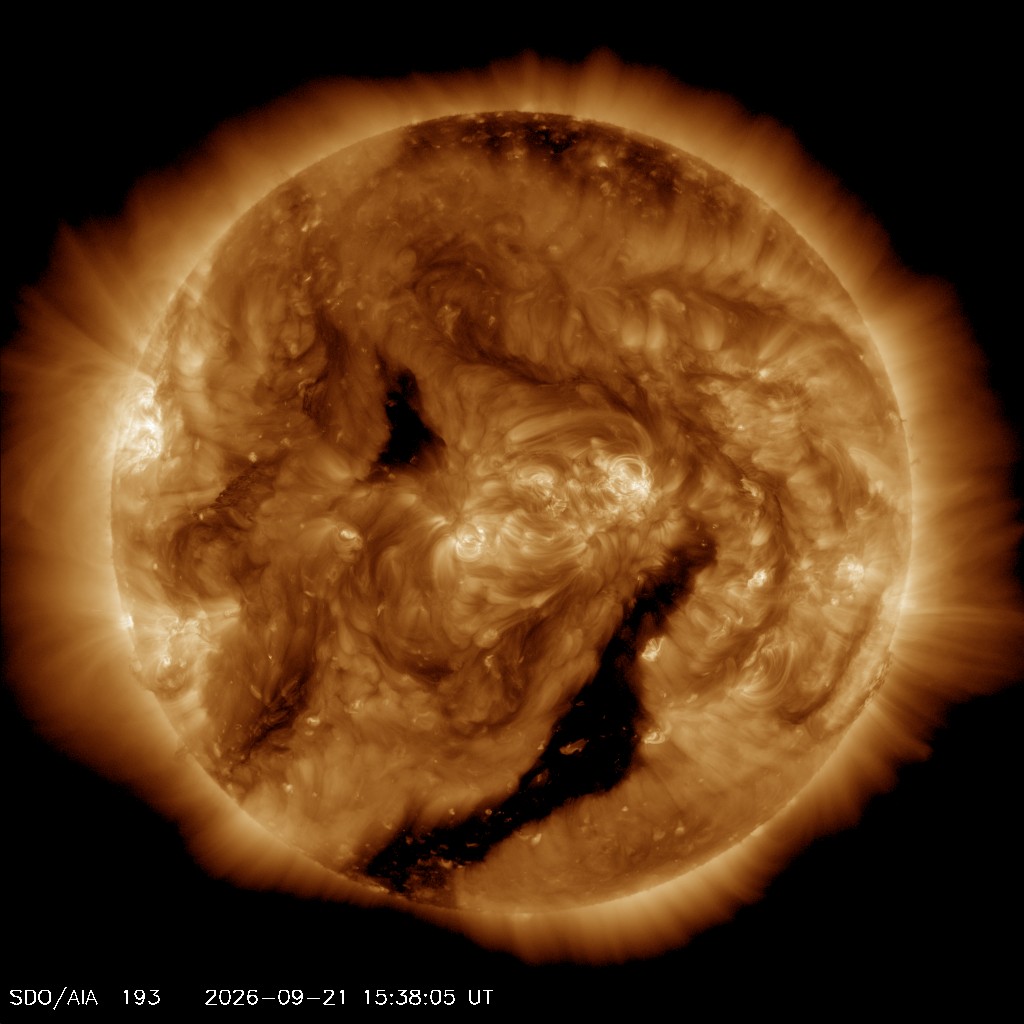
The solar cycle in one minute
The sun's magnetic field winds up and flips over roughly every 11 years. As it does, the number of sunspots, dark, magnetically tangled regions on the surface, rises from almost none at solar minimum to hundreds at solar maximum, then falls back again. Cycles are numbered from 1755. The current one, Solar Cycle 25, began in December 2019.
Sunspots matter for aurora watchers because they're where solar flares and coronal mass ejections (CMEs) come from. CMEs are billion-ton clouds of magnetized plasma, and when one hits Earth with the right magnetic orientation, it produces the big geomagnetic storms that push the aurora toward the equator. (For how that energy turns into light, see what actually causes the northern lights.)
How Solar Cycle 25 played out
Cycle 25 beat expectations. In 2019, the NOAA/NASA prediction panel forecast a modest cycle peaking around mid-2025 with a smoothed sunspot number of about 115, similar to the weak Cycle 24. Instead, activity climbed faster and higher. NASA and NOAA announced in October 2024 that the sun had reached its maximum period, and NOAA's data now shows the smoothed sunspot number peaking at 160.9 in October 2024.
That peak brought some memorable nights:
- 10–11 May 2024: a G5 (extreme) geomagnetic storm, the first since the Halloween storms of October 2003. Aurora was photographed as far south as Florida, northern India and southern Europe.
- 10 October 2024: a G4 (severe) storm brought aurora across much of the US and Europe again, just as maximum was being announced.
- 2025 into 2026: repeated strong storms continued through the cycle's top, keeping mid-latitude sightings unusually common.
Since then the trend is clearly down. The smoothed sunspot number had fallen to 94.5 by March 2026, and the monthly value for September 2026 was 60.3. Sunspot maximum is over.
Why the declining phase is great for aurora
Here's the part most "solar maximum is over" headlines miss: sunspots and geomagnetic storms don't peak at the same time. Long records of geomagnetic indices show that activity at Earth often stays high, or reaches its highest levels, in the years after sunspot maximum. There are two reasons.
1. Coronal holes move toward the sun's equator
As a cycle winds down, large coronal holes, regions where the sun's magnetic field opens out into space, grow and stretch toward low solar latitudes. They release high-speed solar wind streams of 600–800 km/s that sweep past Earth as the sun rotates. Because the sun turns about once every 27 days as seen from Earth, the same coronal hole can bring storms back on a predictable rhythm for months. These are usually G1–G2 storms, but they're frequent and reliable, and at high latitudes that means lots of good aurora nights.
2. Big eruptions don't stop at maximum
Fewer sunspots means fewer chances for an eruption, not none. Some of the strongest events on record came well after maximum:
- The Halloween storms (October–November 2003) came about three years after Cycle 23's maximum. They included one of the largest flares ever measured and brought aurora to the Mediterranean and the southern US.
- September 2017, late in the weak Cycle 24, produced that cycle's two biggest flares (X9.3 and X8.2) and a G4 storm, close to solar minimum.
So the declining phase gives you both: a steady supply of recurring coronal-hole storms, plus occasional large CMEs from the remaining active regions.
What to expect in 2026 and 2027
Nobody can forecast individual storms more than a few days ahead. But based on the current trend and past cycles, here's a realistic picture:
| Where you are | Outlook for 2026–27 and 2027–28 |
|---|---|
| Under the auroral oval (65–72°N) | Excellent. Aurora on most clear, dark nights, with frequent active displays. |
| Sub-auroral (55–62°N) | Good. Regular sightings during G1–G2 coronal-hole storms, especially around the equinoxes. |
| Mid-latitudes (45–55°N) | Occasional. A handful of G3+ storms per year can still bring visible aurora, but less often than in 2024. |
| Low latitudes (below 45°N) | Rare. Requires a G4–G5 event. Possible, as 2003 showed, but not something to plan around. |
Latitudes are geomagnetic approximations. Europe sees aurora farther south than North America at the same geographic latitude, and vice versa for parts of Canada. See reading the Kp index.
The current week is a good example of the declining-phase mix. NOAA's Space Weather Prediction Center is forecasting G1–G2 storm conditions for 10–12 October 2026, driven by several incoming CMEs and a high-speed stream from a coronal hole. We cover it, and the dates to watch this season, in our 2026–27 northern lights season outlook.
When does it really get quiet?
The next solar minimum is expected around 2030, give or take a year or so. In the two or three years either side of it, strong storms become rare, and the aurora largely retreats to its home band around the Arctic and Antarctic circles.
"Quiet" doesn't mean "nothing", though. At places like Tromsø, Abisko, Fairbanks or Yellowknife, aurora is still visible on many clear nights even at solar minimum. What disappears is the mid-latitude spectacle. After that, Solar Cycle 26 is expected to peak sometime in the mid-2030s. How strong it will be is anyone's guess until it begins.
How to use this when planning
- Don't postpone a high-latitude trip. The next two winters are among the best you'll get until the mid-2030s.
- Favor the equinox months. Coronal-hole streams interact with Earth's field most effectively around March and September. Our guide to the best time to see the northern lights explains why.
- Go where the oval is. As activity declines, latitude matters more. See the best places to see the northern lights.
- At mid-latitudes, watch the short-term forecast. Big storms come with one to three days of warning after a CME launches. Check the Kp forecast and real-time solar wind rather than the calendar.
Frequently asked questions
Is the solar maximum over?
The sunspot peak is. NOAA's smoothed sunspot number peaked at 160.9 in October 2024 and has fallen since. But geomagnetic storms often stay frequent, or peak, in the declining years that follow.
Will there be northern lights in 2026 and 2027?
Yes. Aurora happens every year at high latitudes, and activity in 2026–2027 should stay well above solar-minimum levels.
When is the next solar maximum?
Solar minimum is expected around 2030, and the next maximum, of Cycle 26, around the mid-2030s.
Why are auroras still strong after solar maximum?
Coronal holes spread toward the sun's equator and send fast solar wind streams to Earth every 27 days, and large eruptions still occur. The Halloween storms of 2003 came three years after maximum.
References
- NOAA Space Weather Prediction Center, Solar Cycle Progression and observed solar cycle indices (JSON), accessed 10 October 2026.
- NOAA SWPC, Solar prediction scientists announce Solar Cycle 25.
- NOAA / National Weather Service, NOAA forecasts quicker, stronger peak of solar activity (October 2023).
- Mursula, K., Lukianova, R. & Holappa, L. (2015), Occurrence of high-speed solar wind streams over the Grand Modern Maximum, The Astrophysical Journal.
- Space.com, Will 2026 bring strong auroras? What the sun's recent activity tells us.
- Space.com, Northern lights may get stronger within the next 2 years as the sun enters a turbulent decline.
- NASA Solar Dynamics Observatory, The Sun Now (AIA 193 Å image).