- Probably yes, sometimes. Many people in the far north report crackles, hisses and claps during strong aurora, and microphones in Finland have recorded sounds that line up with geomagnetic activity.
- The sound is not made where the lights are. The aurora is around 100 km up. Sound from there would take about five minutes to reach you and would be far too faint.
- Leading theory: electrical discharges in a layer of warm air sitting on top of colder air, around 70–80 metres above the ground, triggered by the same magnetic storm that drives the aurora.
- Not settled: other explanations exist, and most people under the aurora never hear anything.
What people say they hear
Accounts of aurora sounds go back centuries, from northern Scandinavia, Finland, Canada and Alaska. They tend to describe the same few things:
- Crackling or popping, like a wood fire or static on a radio.
- Hissing or rustling, like wind through grass or silk being shaken.
- Sharp claps or snaps, short and distinct, sometimes several in a row.
Almost all reports come from strong displays, on cold, still nights, from people well away from towns. Experienced guides and researchers who have spent hundreds of nights under the aurora mostly report hearing nothing at all. Both things can be true: the sound, if it is real, seems to need unusual conditions.
Why scientists doubted it
The light of the aurora comes from gas between about 100 and 300 kilometres up, where the air is far thinner than at the top of Mount Everest. That causes two problems for any sound made there:
- It would be far too late. Sound travels at roughly a third of a kilometre per second. From 100 km up, it would take about five minutes to reach the ground. People who report aurora sounds say they change with the lights, at the same moment.
- It would be far too faint. Thin air carries sound poorly, and the long journey down would absorb and spread out whatever was left.
So for a long time the usual answer was that people were "hearing" what they saw, a well known effect where the brain fills in sound for movement. That explanation does not survive the next part.
The Finnish recordings
Unto K. Laine, an acoustics researcher at Aalto University in Finland, has spent more than two decades trying to record aurora sounds with microphones rather than relying on memories.
- 2011: during an intense aurora, an array of microphones picked up several distinct claps, and comparing the arrival times at each microphone pointed to a source in the air above, not on the ground.
- March 2013: during a strong display over southern Finland, with temperatures around −20 °C, Laine recorded hundreds of candidate sounds near the village of Fiskars.
- 2022: analysing recordings from Fiskars, he found sounds even on nights when no aurora was visible. Using geomagnetic measurements taken independently, he could predict when the sounds would appear in his recordings with about 90 percent accuracy.
That last result matters most. If the sound appears when the magnetic field is disturbed, whether or not anyone can see the lights, then it is not imagination. Something physical is happening, linked to the geomagnetic storm rather than to the light itself.
The leading explanation: discharges in an inversion layer
Laine's explanation starts close to the ground. On clear, calm, cold nights, the ground loses heat fast and the air next to it cools. A layer of slightly warmer air can end up sitting on top, a temperature inversion. In his 2016 work, he matched recorded sounds with temperature profiles from the Finnish Meteorological Institute and placed the source at about 70 metres; later analysis put it at around 78–80 metres.
The proposed mechanism goes like this:
- Over a calm evening, electric charge builds up on either side of the inversion layer: positive charge from above and negative charge from below.
- A geomagnetic storm, the same one that makes the aurora, changes the electric conditions in the atmosphere.
- The stored charge discharges across the layer in small sparks. Each spark makes a crackle or a clap, and a measurable magnetic pulse.
This would explain several things at once: why the sounds happen during geomagnetic activity, why they are heard at the same moment as the lights change, why they come from above, and why they are reported mainly on calm, cold nights, when inversions form. Laine has also linked the timing of the sounds to Schumann resonances, natural electromagnetic waves that ring around the whole planet between the ground and the upper atmosphere.
Other explanations
Electrophonic sound. Some bright meteors are "heard" at the moment they are seen, which is also impossible for sound made high up. One explanation is that very low frequency (VLF) radio waves reach the ground at the speed of light and make nearby objects vibrate: pine needles, dry grass, hair, the frames of glasses. The same idea has been proposed for the aurora. Researchers who tested it in the 1980s argued that the radio waves are too weak to explain what people hear, so this one remains disputed.
Ordinary cold-night sounds. Snow settling, ice cracking on a lake, trees in frost and distant traffic all carry far on still, freezing nights. Some reported aurora sounds are surely these, heard at a moment when people happen to be listening very hard.
Expectation. Seeing fast movement can make the brain expect sound. This cannot explain microphone recordings, but it can explain why some people are certain they heard something nobody else did.
The "chorus" you can hear with a radio
There is a second, completely different set of aurora "sounds" that is not in doubt at all, because it is not sound. Geomagnetic storms produce natural radio waves at very low frequencies, in the same range as audible sound. Played through a speaker, they sound like rising whistles, chirps and twittering, which is why one type is called the auroral chorus or dawn chorus. Others are known as hiss and whistlers.
You cannot hear these with your ears, because they are radio waves, not vibrations in the air. A simple VLF radio receiver far from power lines will pick them up, and satellites studying Earth's radiation belts record them routinely. When you see a video titled "the sound of the northern lights", it is very often this chorus.
How to listen for it yourself
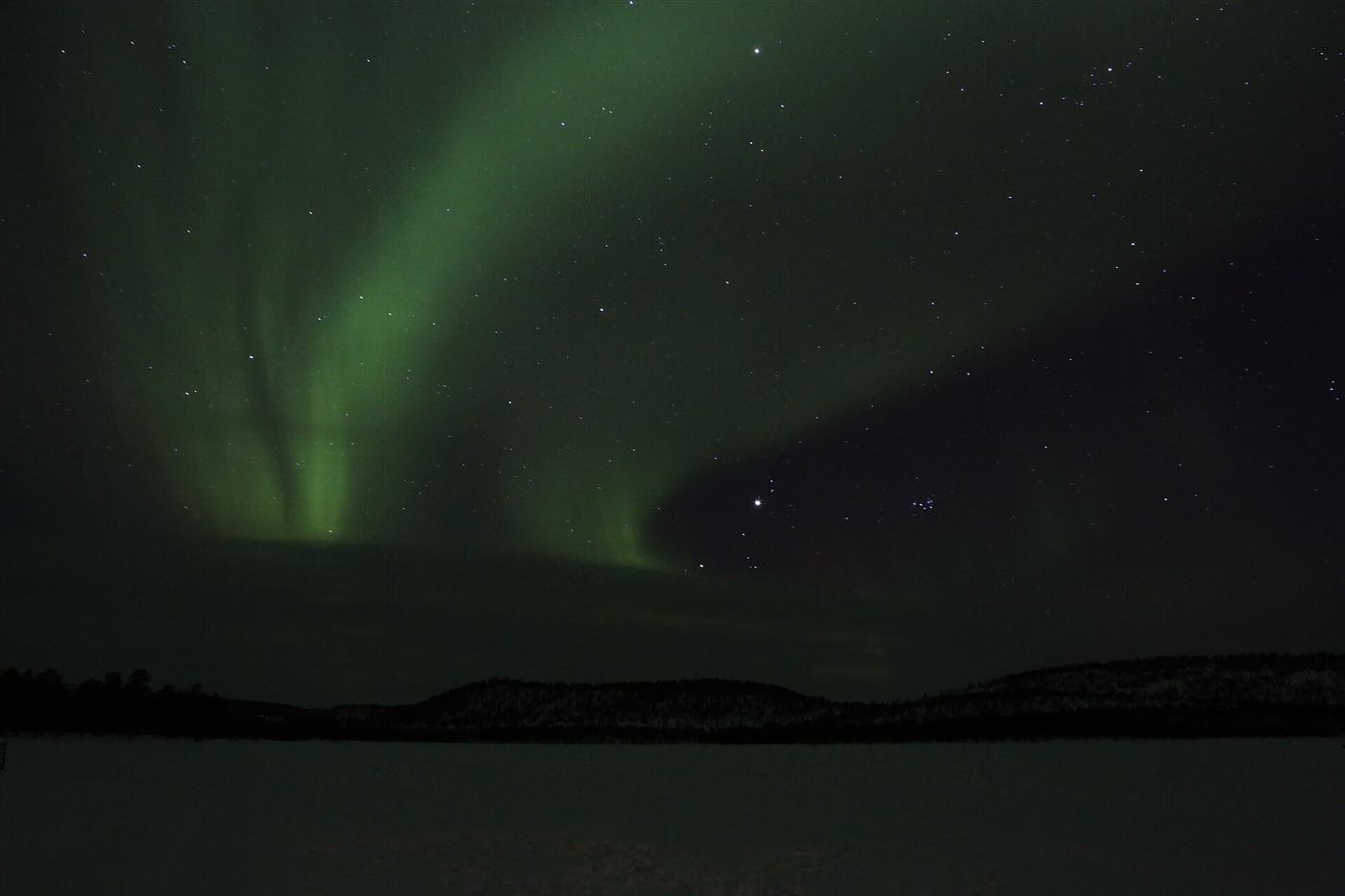
Nobody can promise you will hear anything, but if you want the best chance:
- Pick a strong night. Reports cluster around geomagnetic storms. Our guide to the Kp index explains the scale, and the live conditions page shows it in real time.
- Pick a calm, clear, cold night. Those are the conditions for a temperature inversion. Frost on the ground, smoke rising straight up and still air are good signs. Wind breaks inversions up.
- Get away from noise. Roads, rivers, generators and people talking will cover anything faint. Valleys and lakes away from traffic are best.
- Stay still and quiet. Your own jacket rustles more than you think.
- Record it. Leave a phone recording in a quiet spot, ideally with a windshield over the microphone. Recordings can be checked later against geomagnetic data, which is exactly how the Finnish work was done.
And keep looking up while you listen. Our guide to what the aurora looks like to the naked eye explains why it can look grey at first, and how to tell when it is worth getting the camera out.
Sources
- Aalto University, Acoustics researcher finds explanation for auroral sounds (2016).
- Aalto University, The aurora borealis can be heard even when they can't be seen (2022).
- Aalto University, Auroral crackling sounds are related to the electromagnetic resonances of the Earth.
- National Geographic, Mystery of the northern lights' sounds.
- A. Ol'khovatov, Electrophonic sounds from meteors and auroral audibility (arXiv, 2021), including the 1980s objections.
- Auroral chorus, overview of VLF chorus emissions.

Frequently asked questions
Do the northern lights make a sound?
Sometimes, apparently, but not from the lights themselves. Recordings in Finland have captured crackles and claps that match geomagnetic activity. The leading explanation is electrical discharge in a temperature inversion layer about 70 to 80 metres above the ground, triggered by the same storm that causes the aurora.
What do the northern lights sound like?
People describe crackling or popping like a fire, hissing or rustling like wind in grass, and sharp claps. The whistling and chirping in many online videos is usually the auroral chorus, natural radio waves converted to sound by a receiver.
Why can't sound travel from the aurora to the ground?
The aurora is about 100 kilometres up or higher, where the air is extremely thin. Sound from there would take around five minutes to reach the ground and would be absorbed and spread out to almost nothing, so it could not match the lights moment to moment.
Who studies the sounds of the aurora?
The best known researcher is Unto K. Laine of Aalto University in Finland, who has recorded aurora-related sounds since the early 2000s, including hundreds of sounds near Fiskars in March 2013.
Can you hear the aurora when it is not visible?
According to Laine's 2022 analysis, yes. His recordings contained sounds on nights with no visible aurora, and he could predict them from independent geomagnetic data with about 90 percent accuracy.
When am I most likely to hear the northern lights?
During a strong geomagnetic storm, on a calm, clear and very cold night when a temperature inversion forms, in a quiet place away from roads and wind. Even then most people hear nothing, so recording with a phone is a good idea.