- What it looks like: a narrow mauve or purple-white ribbon running east to west, usually south of the main aurora, lasting from about 20 minutes to an hour. Sometimes short green vertical stripes, the "picket fence", appear below it.
- What it is: light from an extremely hot, fast-moving river of charged gas in the upper atmosphere, a few hundred kilometres up. It is not made by particles raining down, which is how a normal aurora works.
- The name: amateur aurora chasers in Alberta, Canada called it "Steve". Scientists later made it an acronym: Strong Thermal Emission Velocity Enhancement.
- When to look: on active nights, typically an hour or so after a burst of aurora, low in the sky toward the pole or even overhead at mid latitudes.
What STEVE looks like
STEVE is easy to recognise once you know it. Where the aurora is a broad glow, curtains or rays that shift and change, STEVE is:
- Narrow, like a thin ribbon or a contrail, often just a few degrees wide.
- Long, running east to west for hundreds or even thousands of kilometres.
- Mauve, pinkish purple or whitish, not the green of most aurora.
- South of the aurora (in the northern hemisphere). From mid latitudes it can appear high in the sky or even overhead while the aurora sits low on the northern horizon.
- Fairly steady, drifting slowly westward, and fading after 20 minutes to an hour.
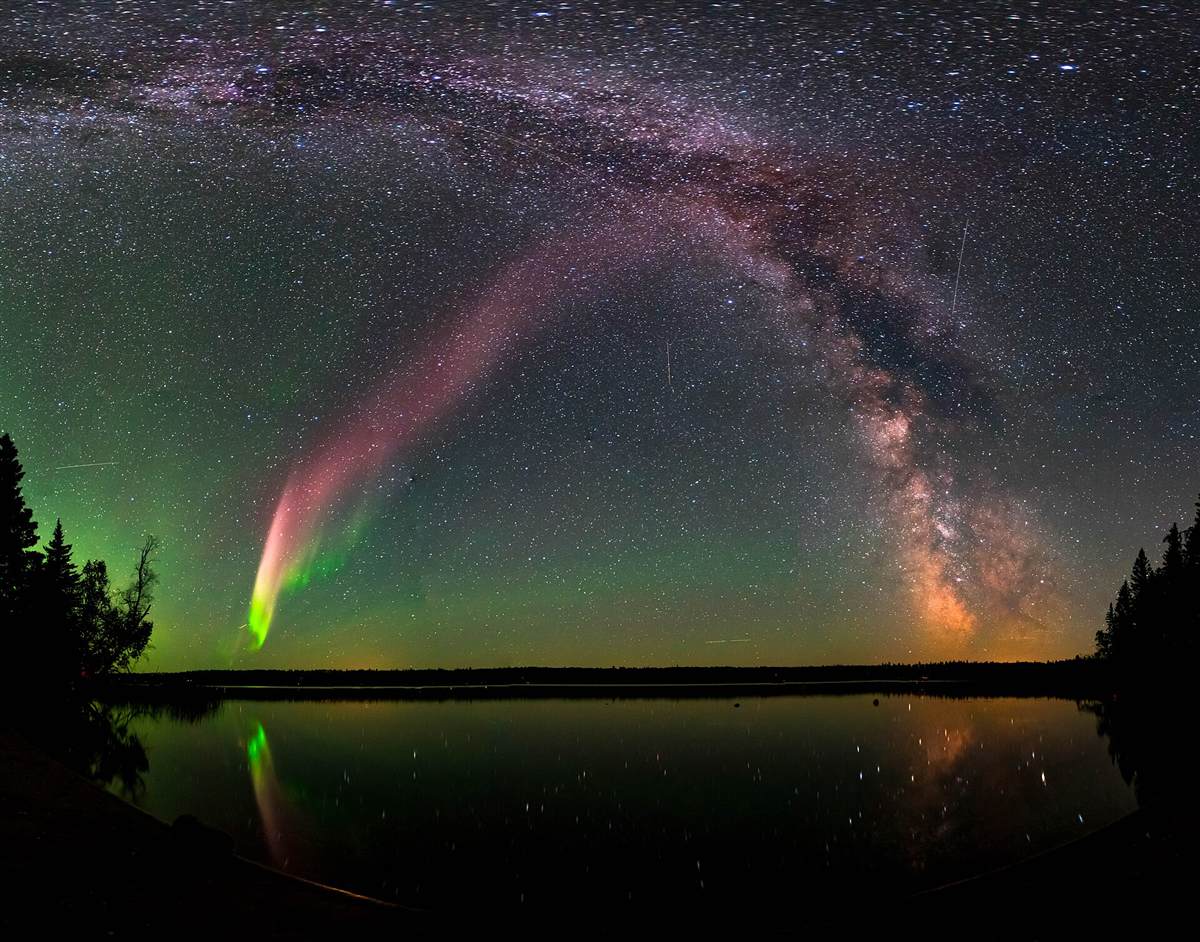
On some nights a row of short green streaks appears beneath the ribbon, a little like the posts of a fence. That is the picket fence, and it is a separate thing again.
How a sky phenomenon got the name Steve
People had photographed the purple ribbon for years, but it was usually filed under "proton arc" or just "aurora". In 2015 and 2016, members of the Alberta Aurora Chasers, a Facebook group of amateur photographers in Canada, kept posting pictures of it and wondered what it was. With no scientific name available, they called it Steve, after a line in the animated film Over the Hedge, where characters give a name to something they do not understand.
Scientists at the University of Calgary saw the photos and recognised that it did not match anything in the textbooks. Later in 2016, once satellite data came in, researchers suggested turning the name into an acronym: STEVE, Strong Thermal Emission Velocity Enhancement, which describes what was measured. It is one of the best examples of citizen science leading to a real discovery.
What the satellite found
Using the timestamps and locations from the amateur photos, scientists looked for times when a satellite had flown through STEVE. The European Space Agency's Swarm satellites, which measure Earth's magnetic field and the upper atmosphere, had flown right through it, a few hundred kilometres up. According to ESA, the measurements showed:
- a narrow ribbon of gas, about 25 km wide, flowing westward at around 6 km/s, while the gas either side barely moved;
- a temperature jump of about 3,000 °C inside the ribbon compared with the gas around it.
The results were published in Science Advances in March 2018 by a team led by Elizabeth MacDonald of NASA, with co-authors from the University of Calgary and members of the public. They linked STEVE to a known but rarely seen process called a subauroral ion drift: a fast, narrow flow of charged particles just south of the auroral zone.
Why STEVE isn't an aurora
An ordinary aurora is made by electrons and protons streaming down along Earth's magnetic field and crashing into the upper atmosphere. Each collision gives a little energy to an oxygen or nitrogen atom, which releases it as light: green and red from oxygen, blue and purple from nitrogen. (More in what causes the aurora.)
STEVE works differently. Another 2018 study, led by Bea Gallardo-Lacourt at the University of Calgary, checked satellite data from a pass right over STEVE and found no particles raining down beneath it. The light seems instead to come from the gas being heated and driven by the fast flow itself, a kind of glow rather than an aurora. Researchers at the University of California, Berkeley, describe it this way: STEVE's mauve light comes from heating of charged particles high up, while ordinary aurora comes from particles falling in.
So STEVE happens on aurora nights, because it is driven by the same disturbances in Earth's magnetic field, but strictly speaking it is not an aurora.
The green picket fence
The short green stripes that sometimes appear below STEVE, at around 100 to 150 km altitude, look more like aurora, and for a while they were thought to be ordinary aurora. Work led by Claire Gasque at Berkeley suggests they are something else again. Her team's models show that a strong electric field running along Earth's magnetic field can speed up the electrons already present in the atmosphere enough to make that green light, without any particles arriving from space. Gasque has called it a completely different mechanism from any aurora studied before.
The order of events also hints that they are separate: STEVE usually appears first, the picket fence may develop while it glows, and the fence can outlast the purple arc.
STEVE, SAR arcs and ordinary aurora
| Aurora | STEVE | SAR arc | |
|---|---|---|---|
| Colour | Mostly green, also red, pink, purple | Mauve, pinkish purple or whitish, sometimes with green fence | Deep red, very faint |
| Shape | Broad glow, curtains, rays, arcs | Narrow ribbon, east to west | Wide, smooth band |
| Movement | Often fast, dancing | Slow westward drift | Almost still, for hours |
| How long | Minutes to hours, in bursts | About 20 minutes to an hour | Hours |
| Cause | Particles raining down | Hot, fast-flowing gas (subauroral ion drift) | Heat leaking down from the ring current |
| Seen by eye? | Often | Often, as a pale grey or pinkish streak | Rarely; mostly on camera |
The stable auroral red (SAR) arc is another non-aurora glow that appears during strong storms. It is much broader and dimmer than STEVE.
How and when to spot STEVE
- Pick an active night. STEVE comes with geomagnetic activity, usually during or after a substorm, the sudden brightening of the aurora. Check the live conditions and our Kp guide.
- Keep watching after the peak. STEVE often appears roughly an hour after a burst of aurora, when many people have already gone back inside.
- Look south of the aurora. From places like Alberta, the northern US, Scotland or southern Scandinavia, it can stretch high across the sky, even overhead, while the aurora stays low in the north.
- Look around the equinoxes. STEVE appears more often in spring and autumn than in summer or winter, a pattern scientists have not fully explained yet.
- It is fairly rare. Even keen aurora chasers can go a season without seeing it. Big storms, such as those of May and October 2024, produced many STEVE photos from unusually far south.
Photographing STEVE
Cameras pick up STEVE's colour better than eyes, which often see it as a faint grey or pinkish streak. The same settings as for aurora work well:
- a wide-angle lens, because STEVE can cross the whole sky;
- exposures of about 2 to 8 seconds at ISO 1600–3200 on a camera, or night mode on a phone;
- a tripod or something steady to lean the phone against;
- note the exact time and your location. Researchers still use amateur photos, and projects such as Aurorasaurus collect sightings.
Our aurora photography basics and phone camera settings cover the rest.
Sources
- ESA, Getting to know Steve.
- NASA, Mystery of purple lights in sky solved with help from citizen scientists (2018).
- University of Calgary, Space physicists and citizen scientists shed light on mystery of STEVE (2018).
- UC Berkeley Physics, When is an aurora not an aurora?
- NSF, Scientists discover what powers celestial phenomenon STEVE.
- National Geographic, Meet 'Steve,' a totally new kind of aurora.

Frequently asked questions
What is STEVE in the sky?
STEVE is a narrow mauve or purple ribbon of light that runs east to west across the sky on active aurora nights, usually south of the aurora. It is produced by a very hot, fast-flowing stream of charged gas a few hundred kilometres up, called a subauroral ion drift.
What does STEVE stand for?
Strong Thermal Emission Velocity Enhancement. The name Steve came first, from amateur aurora chasers in Alberta, Canada, and scientists turned it into an acronym afterwards.
Is STEVE an aurora?
No. An aurora is made by particles from space hitting the atmosphere. Satellite data show no particles raining down beneath STEVE. Its light comes from gas heated and driven by a fast flow in the upper atmosphere, although it happens during the same geomagnetic activity as the aurora.
What is the green picket fence under STEVE?
A row of short green stripes that sometimes appears below STEVE at around 100 to 150 km. Research from UC Berkeley suggests it is made by electric fields along Earth's magnetic field speeding up local electrons, a different mechanism from both STEVE and ordinary aurora.
Can you see STEVE with the naked eye?
Yes, often as a pale grey, whitish or pinkish streak. A camera or a phone in night mode shows its mauve colour more clearly.
When is STEVE most likely to appear?
On geomagnetically active nights, typically about an hour after a burst of aurora, and more often around the spring and autumn equinoxes. Look south of the main aurora.