Update, 10 Oct 19:45 UTC: a CME arrived about a day early and the storm reached G3 (Kp 7), stronger than forecast. Read the live coverage: strong G3 geomagnetic storm underway.
Time-sensitive: the storm forecast below is based on NOAA's 3-day forecast issued 00:30 UTC on 10 October 2026. Space weather forecasts change quickly. Always check the latest official forecast before heading out. The season calendar further down stays valid through April 2027.
- Forecast: G1 (minor) storms late on 10 Oct and on 11 Oct, G1–G2 (moderate) early on 12 Oct (UTC). Maximum expected Kp ≈ 5.67.
- Cause: several coronal mass ejections plus a high-speed stream from a coronal hole.
- Sky conditions: new moon on 10 Oct, so no moonlight all weekend. Clouds are the main wildcard.
- Who's best placed: Scandinavia, Iceland, Scotland, Canada and the northern US. Farther south, look low on the northern horizon and use a camera.
- Season ahead: the next new moons fall on 9 Nov and 9 Dec. The March equinox (20 Mar 2027) is the next big geomagnetic window.
- Rest of the month: see our northern lights forecast for October 2026.
What NOAA is forecasting for 10–12 October
NOAA's Space Weather Prediction Center (SWPC) expects geomagnetic activity to build through the weekend as several coronal mass ejections (CMEs), launched from the sun earlier in the week, arrive one after another. A high-speed solar wind stream from a negative-polarity coronal hole is expected to add to the disturbance. This one-two punch of eruptions and coronal-hole wind is typical of the declining phase of the solar cycle, which we explain in Northern Lights in 2026 and 2027.
| Period (UTC) | Expected level | Notes |
|---|---|---|
| Sat 10 Oct, late | G1 · minor (Kp 5) | First CME effects expected. Earlier in the day stays near Kp 2–4. |
| Sun 11 Oct | G1 · minor (Kp 5) | Activity strongest in the later UTC hours. |
| Mon 12 Oct, early | G1–G2 · minor to moderate (Kp 5–6) | Additional CMEs plus coronal-hole wind. Forecast peak Kp ≈ 5.67, then subsiding. |
Source: NOAA SWPC 3-day forecast, issued 2026-10-10 00:30 UTC. Kp values are 3-hour forecasts. CME arrival times are typically uncertain by ±6–12 hours.
The sun is also busy in other ways. SWPC gives a 55% daily chance of R1–R2 radio blackouts (from M-class flares) and a 10% chance of a stronger R3 event, mostly from active sunspot Region 4549. A large flare from that region could launch another CME, so this forecast may well be extended.
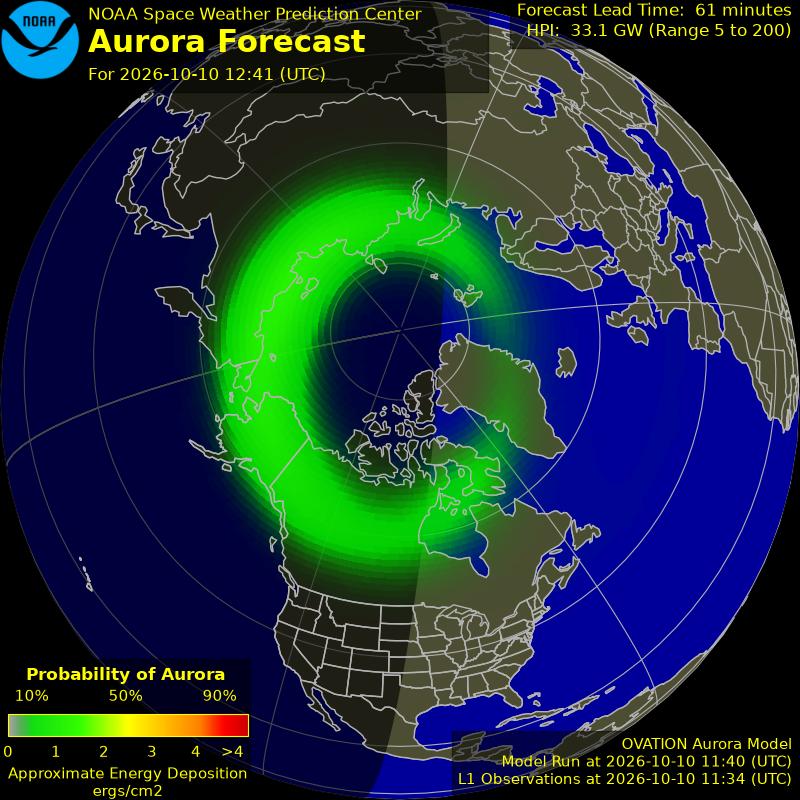
Who can see it, and when to look
A G1–G2 storm typically brings visible aurora to these latitudes:
- Overhead or high in the sky: Iceland, northern Norway, Sweden and Finland, Alaska and most of Canada.
- Clearly visible to the north: Scotland, southern Scandinavia, the Baltic states, and the northern tier of US states (Washington to Maine, including Montana, the Dakotas, Minnesota, Wisconsin and Michigan).
- Possible low on the horizon, best by camera: northern England, Ireland, northern Germany and Poland, and US states a little farther south, if the storm reaches the top of its forecast range.
Translating the UTC timing into local nights
Geomagnetic storms only matter if they peak while it's dark where you are. Based on the current timing:
- Europe: the "late 10 October" window lands in the evening of Saturday 10 October. The "early 12 October" window falls in the small hours of Monday morning, 12 October, still dark across Europe until about 6–7 AM.
- North America: early 12 October UTC is the evening of Sunday 11 October in North America, about 8 PM to 2 AM Eastern or 5–11 PM Pacific. That makes Sunday night the most promising for the US and Canada.
Whatever the forecast says, the best hours are still roughly 10 PM to 2 AM local time. See the best time to see the northern lights for why.
Why the new moon helps
The new moon on 10 October means no moonlight all weekend. Faint aurora that a bright moon would wash out will be visible to anyone away from city lights. At mid-latitudes, where aurora usually shows only as a low glow, that can make all the difference. (More in why the moon and city lights can ruin your aurora photos.) If you're farther south and see only a faint grey band, point your phone at it. Cameras pick up color the eye can't, as explained in can you see the northern lights with the naked eye?
The 2026–27 aurora season calendar
Beyond this weekend, these are the dates to plan around. New moon weeks give the darkest skies. Full moon weeks are still workable for bright displays, but faint aurora will be harder to see.
| Month | New moon (darkest) | Full moon (brightest) | Also worth knowing |
|---|---|---|---|
| Oct 2026 | 10 Oct | 26 Oct | Clocks go back on 25 Oct in Europe, so the aurora's peak hours move an hour earlier on the clock. |
| Nov 2026 | 9 Nov | 24 Nov | US and Canada end daylight saving on 1 Nov. Watch 6–8 Nov for a possible return of this weekend's coronal-hole stream (see below). |
| Dec 2026 | 9 Dec | 24 Dec | Winter solstice on 21 Dec: the longest nights of the year. Geminid meteors peak 13–14 Dec under a young moon. |
| Jan 2027 | 7 Jan | 22 Jan | Polar night ends at Tromsø around mid-January. Often the coldest and clearest inland conditions. |
| Feb 2027 | 6 Feb | 20 Feb | The equinox effect starts building. Often the clearest month in Finnish Lapland and interior Alaska. |
| Mar 2027 | 8 Mar | 22 Mar | March equinox on 20 Mar, statistically one of the most active weeks of the year. |
| Apr 2027 | 6 Apr | 20 Apr | The season closes as nights shorten. Late opportunities around the new moon. |
Moon phase dates in UTC. Depending on your time zone, a phase may fall on the previous or next calendar day.
Watch for the 27-day echo
The sun rotates about once every 27 days as seen from Earth. If this weekend's coronal-hole stream delivers, the same hole may face Earth again around 6–8 November, just before the 9 November new moon. Coronal holes change shape and don't always survive a full rotation, but recurring streams are one of the few weeks-ahead clues space weather gives us.
Three windows to circle
- Now to early November: the tail of the autumn equinox season, long nights, and two dark new-moon weeks (10 Oct and 9 Nov).
- Mid-December to mid-January: the longest nights of the year around the 21 December solstice. Fewer storms on average, but the most hours of darkness to catch one.
- Late February to late March: the spring equinox window. Often the best mix of activity, clear skies and manageable cold. The 8 March new moon falls less than two weeks before the equinox.
For destinations, see our guide to the best places to see the northern lights.
How to follow the forecast
- NOAA SWPC publishes the official 3-day forecast, storm watches and real-time solar wind data used by most aurora services.
- The UK Met Office Space Weather Operations Centre issues its own forecasts and aurora outlooks for the UK and Europe.
- Live aurora webcams show what the sky is doing right now under the auroral oval. See our aurora webcams page.
- Your local cloud forecast matters just as much. Check short-range cloud cover in the afternoon, and be ready to drive to a clear patch.
Frequently asked questions
Will the northern lights be visible this weekend (10–12 October 2026)?
Possibly, for many people. NOAA forecasts G1 storms late on 10 Oct and on 11 Oct, and G1–G2 early on 12 Oct (UTC), with a maximum Kp of about 5.67. The new moon means dark skies. Northern Europe, Canada and the northern US are best placed, if it's clear.
What are the best dates to see the northern lights in winter 2026–27?
The weeks around each new moon (10 Oct, 9 Nov, 9 Dec, 7 Jan, 6 Feb, 8 Mar and 6 Apr), and especially the weeks around the March equinox on 20 March 2027.
How accurate are aurora forecasts?
CME arrival times can be off by many hours, and storm strength depends on the CME's magnetic orientation, which can only be measured about 30–60 minutes before it arrives. Treat a 3-day forecast as "be ready", not "guaranteed".
References
- NOAA Space Weather Prediction Center, 3-Day Forecast, issued 2026-10-10 00:30 UTC.
- NOAA SWPC, Aurora – 30 Minute Forecast (OVATION model).
- NOAA SWPC, NOAA Space Weather Scales (G, S and R levels).
- UK Met Office, Space weather forecast.
- Forbes, Northern lights alert: 28 states may see aurora this weekend as 3 CMEs approach (9 October 2026).
- Forbes, Northern lights could be visible in 10 states tonight as geomagnetic storm watch issued (8 October 2026).
- Space.com, Northern lights possible across the US on Oct. 9–10 as 4 CMEs head for Earth.
- Catalina Sky Survey / University of Arizona, Moon phase calendar.