Forecast basis: NOAA SWPC's 27-day outlook issued 23 November 2026, which runs to 19 December, and observed daily Kp up to 25 November. Dates from 20 December on are our own projection, one solar rotation (27 days) on from late November, and are marked as such in the chart and table. NOAA updates the outlook every Monday, and we will update this page when it changes.
- 4–5 December: NOAA forecasts Kp 5 (G1) on 4 December and Kp 4 on 5 December. The same stream gave a G1 storm on 7–8 November. The waning moon rises late, so evenings are dark.
- 5–13 December: the new moon (9 December) brings the darkest skies of the month. NOAA expects a quiet week (Kp 2), which is still enough for the Arctic.
- 13–14 December: the Geminid meteor shower peaks five days after new moon, in a dark sky. Kp rises to 3–4 on 15–16 December.
- 21 December: the winter solstice and the longest night of the year.
- 23–25 December: the coronal hole behind October's G2 storm and Halloween's Kp 6 is due back around Christmas Eve (our projection). That is also the night of the full Cold Supermoon.
- 31 December: the 4 December stream may return one rotation later, for a possible New Year's Eve show (our projection).
- Why December is different
- How our November forecast did
- The three storm streams to watch
- December 2026 forecast, day by day
- Best dates to see the northern lights
- Moon phases in December 2026
- Geminids and Ursids
- How dark it gets: daylight at the solstice
- Clouds: the real December forecast
- Where to go in December
- How reliable is this forecast?
- FAQ
Why December is different
December gives you more darkness than any other month. North of the Arctic Circle the sun does not rise at all for weeks, and even in Scotland or Minnesota the sky is dark from late afternoon. More dark hours means more chances to be outside when a burst of aurora happens.
Two things work against it. First, geomagnetic activity is, on average, a little lower around the solstices than around the equinoxes in March and September. The reason is the tilt of Earth's magnetic field relative to the solar wind, known as the Russell–McPherron effect. It is a statistical nudge, not a rule: plenty of strong storms have happened in December. Second, and more important, December is often cloudy along the coasts of Norway, Iceland and Scotland. In most places, cloud will decide your December more than the Sun will (see how to read a cloud forecast below).
How our November forecast did
A monthly aurora forecast is only useful if it is roughly right, so here is how the dates in our November 2026 forecast turned out against the observed planetary Kp from NOAA.
| Window | What we expected | What happened |
|---|---|---|
| 31 Oct–1 Nov | Kp 5 (G1), NOAA outlook | Kp 6 (G2) late on 31 Oct, Kp 4.67 early on 1 Nov. Stronger than forecast. |
| 8–10 Nov | Up to Kp 4, new moon | Kp 5.33 (G1) on the evening of 7 Nov (UTC) and Kp 5 early on 8 Nov. Stronger than forecast. |
| 17–19 Nov | Our projection: active, chance of G1 | Quiet on 17 Nov (Kp 3), then Kp 5 (G1) at 00–03 UTC on 19 Nov, the evening of 18 Nov in North America. About a day later than expected. |
| 27–28 Nov | Our projection: Kp 5 | NOAA now forecasts Kp 5 for 27 Nov. Still to come at the time of writing. |
Observed values: NOAA SWPC daily geomagnetic indices, estimated planetary Kp, 3-hour values.
The pattern is typical of the declining phase of the solar cycle. The dates of recurring storms are fairly predictable, the exact day can slip by one, and the strength is the least certain part. That is how to read everything below.
The three storm streams to watch in December
The Sun turns once every 27 days or so, as seen from Earth. A long-lived coronal hole, a region that lets fast solar wind escape, therefore faces Earth again about every 27 days, and the storms it causes repeat on a schedule. This autumn, three streams have done exactly that:
| Stream | Past visits (max Kp) | Next visit | After that |
|---|---|---|---|
| The Halloween stream | 4 Oct (5.67, G2) · 31 Oct (6, G2) | 27 Nov: NOAA forecasts Kp 5 | ~24 Dec (projection) |
| The early-November stream | 7–8 Nov (5.33, G1) | 4 Dec: NOAA forecasts Kp 5 | ~31 Dec (projection) |
| The mid-month stream | 21–23 Oct (4.67) · 19 Nov (5, G1) | 15–16 Dec: NOAA forecasts Kp 3–4 | ~12 Jan 2027 |
Coronal holes change shape and strength, so each visit can be weaker or stronger than the last, or fail to show at all. They are also not the only source of storms. Eruptions from the Sun (coronal mass ejections, CMEs) caused October's G3 storm and can arrive with only one to three days' warning, on any date. For why big storms keep happening after solar maximum, see northern lights in 2026 and 2027.
December 2026 aurora forecast, day by day
Solid bars are NOAA's 27-day outlook, which ends on 19 December. Dashed bars show the same day one solar rotation earlier, which is the best guide available for the last part of the month. The dashed line marks Kp 5, the threshold for a G1 storm.
| Dates | Expected activity | Moon | Outlook |
|---|---|---|---|
| 1–3 Dec | Kp 2–3, quiet | Last quarter, rises around midnight | Arctic only |
| 4–5 Dec | Kp 5 (G1), then Kp 4 (NOAA) | Waning crescent, dark evenings | Good |
| 6–8 Dec | Kp 2–3 | Thin crescent, dark | Arctic only |
| 9–14 Dec | Kp 2, quiet (NOAA) | New moon 9 Dec, darkest week | Good in the Arctic, Geminids |
| 15–16 Dec | Kp 3–4 (NOAA) | Waxing crescent, sets in the evening | Good |
| 17–21 Dec | Kp 2 to 19 Dec, then projection Kp 2 | First quarter 17 Dec | Arctic only |
| 23–25 Dec | Projection: Kp 4–5 (Halloween stream) | Full supermoon 24 Dec | Watch, but bright moon |
| 26–30 Dec | Projection: Kp 2–3 | Waning gibbous | Arctic only |
| 31 Dec | Projection: Kp 5 | Last quarter, dark evening | Watch |
"Arctic only" means the aurora is still likely under the auroral oval (northern Norway, Sweden, Finland, Iceland, Alaska, northern Canada) on clear nights, but unlikely further south. Kp needed for your area: US states, UK and Ireland.
Best dates to see the northern lights in December 2026
4–5 December: G1 on a dark evening
This is the strongest date in NOAA's outlook. The stream that caused it gave Kp 5.33 on 7 November, a little more than forecast at the time. The moon is a waning crescent, three days after last quarter, and does not rise until the early hours, so the evening is dark. At Kp 5 the aurora can reach northern Scotland, southern Norway and Sweden, and the northern tier of the US and southern Canada, low on the northern horizon. In the Arctic, expect a bright, active night if the sky is clear.
9–14 December: the dark week, for travellers
The new moon on 9 December gives the darkest skies of the month. NOAA expects a quiet week at Kp 2, so this is not a week for watching from Chicago or Manchester. Under the auroral oval it is a different story: Kp 2 in Tromsø, Abisko, Rovaniemi, Iceland or Fairbanks often means a visible arc and, on good nights, moving curtains. With no moonlight, faint colour and structure show up far better. If you are booking a trip, this is the week with the most dark hours and the fewest distractions in the sky.
13–16 December: Geminids, then a stream returns
The Geminid meteor shower peaks on the night of 13–14 December, five days after new moon, when the thin crescent moon sets early in the evening. Then NOAA expects activity to rise to Kp 3 on 15 December and Kp 4 on 16 December, the next visit of the stream that gave a G1 storm on 19 November. Kp 4 brings aurora to southern Iceland, central Scandinavia and southern Alaska, and to northern Scotland on a good night.
21 December: the solstice
The winter solstice falls on 21 December, giving the longest night of the year in the northern hemisphere. It does not bring extra aurora by itself, but in the Arctic it means the sky is dark enough for aurora for well over 18 hours.
23–25 December: a Christmas Eve storm watch, under a supermoon
This is the date most readers will ask about. The coronal hole that caused a G2 storm on 4 October and Kp 6 on 31 October is forecast by NOAA to bring Kp 5 again on 27 November. If it survives one more rotation, it faces Earth around 24 December. That is our projection, not a NOAA forecast, and it could arrive a day early or late, or weaker. NOAA's outlook will cover these dates from 30 November, and we will update this page then.
The catch is the moon. The December full moon, the Cold Moon, is full at 01:28 UTC on 24 December, which is 8:28 pm Eastern on 23 December. It is also the year's closest full moon, a supermoon. A full moon washes out faint aurora, but a G1 or stronger display is bright enough to stand out, especially if you face north with the moon behind you. In the Arctic, where the full moon stays up all night, moonlit snow makes for beautiful photos with the aurora overhead. Planning a holiday trip? See northern lights at Christmas.
31 December: New Year's Eve
One rotation after the 4 December storm lands on 31 December. Again, this is a projection. The moon is around last quarter and rises close to midnight, so the evening is dark. If the stream holds, you could watch the aurora before the fireworks, and the light from the fireworks will not help, so get out of town.
Moon phases in December 2026
| Phase | Date (UTC) | What it means for the aurora |
|---|---|---|
| Last quarter | Around 1 December | The moon rises around midnight, so evenings are dark, including for the 4 December G1 forecast. |
| New moon | 9 December (00:51 UTC) | The darkest skies of the month, roughly 5–13 December. Best for faint aurora and the Geminids. |
| First quarter | 17 December | The moon sets around midnight, leaving the early morning hours dark. |
| Full moon (Cold Supermoon) | 24 December (01:28 UTC; 8:28 pm EST on 23 December) | Bright all night. Only stronger displays stand out, but moonlit landscapes photograph well. |
| Last quarter | Around 31 December | Dark evenings again for New Year's Eve. |
Moonrise and moonset times depend on your latitude. In the high Arctic around the full moon, the moon can stay above the horizon all day and night. More on why it matters in moonlight and light pollution.
The Geminids and the Ursids
The Geminids are the strongest regular meteor shower of the year. Predictions put the 2026 peak in the early hours of 14 December (UTC), so the nights of 13–14 and 14–15 December are both worth watching. Under a truly dark sky, you can see more than a meteor a minute at the best time. Unlike most showers, the Geminids are already active in the evening, because their radiant in the constellation Gemini rises soon after dark, and they peak around 2 am local time when it is highest. This year the moon is a thin crescent that sets early, so conditions are about as good as they get.
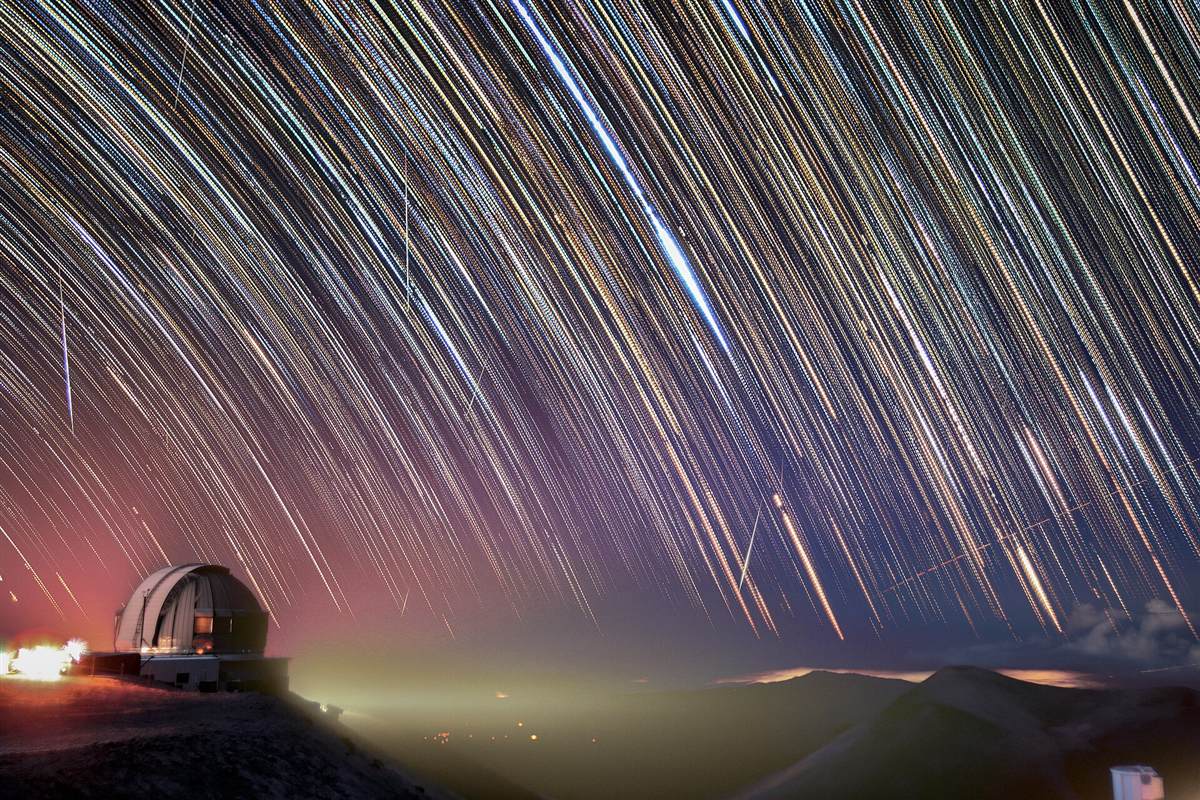
The Ursids peak around 21–22 December, the night of the solstice, with a modest 5 to 10 meteors an hour. Their radiant is near the Little Dipper, so they come from the north, the same direction you face for the aurora.
Meteors and aurora need the same things: darkness, a clear sky and patience. The difference is that meteors are best looked for high in the sky, while aurora at mid latitudes starts low in the north. Lie back, and check the northern horizon every few minutes.
How dark it gets: daylight at the solstice
Hours of darkness matter more in December than anywhere else in the year. Roughly how much daylight there is on 21 December:
| Place | Daylight on 21 December | What it means |
|---|---|---|
| Tromsø, Norway | None (polar night, late November to mid January) | Only a few hours of blue twilight around midday. Aurora possible from mid afternoon. |
| Rovaniemi, Finland | About 2 hours | Dark from mid afternoon. |
| Fairbanks, Alaska | About 3 hours 40 minutes | Sunset before 3 pm. |
| Reykjavík, Iceland | About 4 hours | Sunrise after 11 am, sunset before 3:30 pm. |
| Edinburgh, Scotland | About 7 hours | Fully dark by about 5:30 pm. |
Rounded values. "Fully dark" means after astronomical twilight ends.
Even with all that darkness, aurora activity is not spread evenly through the night. It tends to peak in the hours around magnetic midnight, roughly 10 pm to 2 am local time in most aurora regions, with a second chance in the early morning. In polar night it is worth stepping outside in the late afternoon too: some of the best displays come early on active days.
Clouds: the real December forecast
In December, cloud is the main reason people miss the aurora. A clear sky at Kp 2 beats a cloudy sky at Kp 6. A few habits make a real difference:
- Look at cloud by layer. Most weather apps show "cloudy" for any cloud. Thin high cloud (cirrus) often lets aurora through, while low cloud blocks everything. Forecasts that split low, mid and high cloud, such as Yr in Norway or the Icelandic Met Office's cloud map, are far more useful.
- Watch the satellite loop on the evening itself. Gaps in the cloud move, and a loop shows where they are heading in the next hour or two.
- Go inland. Coastal areas catch weather from the sea. Places in the rain shadow of mountains, such as Abisko in Sweden, inland Finnish Lapland, and Fairbanks in Alaska's interior, are clear much more often.
- Be ready to drive. In northern Norway, a one or two hour drive toward the Swedish or Finnish border often finds clear sky when the coast is overcast. Most guided chases do exactly this.
This is also why our visibility score combines aurora activity with your local cloud and moonlight instead of showing Kp alone.
Where to see the northern lights in December 2026
- Tromsø and northern Norway: polar night, under the oval, but coastal cloud. Plan to chase. Ideas for the daytime in our Tromsø guide and whale, husky and reindeer tours.
- Abisko, Kiruna and Finnish Lapland: inland, often clearer, snowy foregrounds. Very cold, which usually means clear.
- Iceland: long nights and easy to reach, but changeable weather. Stay flexible.
- Fairbanks and Yellowknife: among the most reliable places in the world, thanks to dry, cold continental air.
- Scotland, southern Scandinavia, the northern US and southern Canada: realistic only on the Kp 5 dates, 4 December and possibly 24 and 31 December. Find a dark spot with a low view to the north.
More destinations in the best places to see the northern lights.
Tips for December aurora hunting
- Dress for standing still. You will not be moving much. Layers, insulated boots, a hat and mittens matter more than an expensive jacket.
- Keep batteries warm. Cold drains phone and camera batteries fast. Carry spares in an inside pocket.
- Give your eyes 20 minutes. Faint aurora looks grey to the eye at first. A phone camera in night mode often shows the colour before you do. Settings in our phone camera guide.
- Watch Bz on the night. When the solar wind's magnetic field (Bz) turns south and stays there, activity usually follows within the hour. Live values on our northern lights tonight page.
- Let an alert do the waiting. See how to get northern lights alerts on your phone.
How reliable is this forecast?
The dates to 19 December come straight from NOAA's 27-day outlook. It works well for recurring coronal hole streams and, as November showed, it can underestimate them as well as overestimate them. The dates from 20 December are our own projection using the same 27-day logic. Use them to decide which nights to keep free, not to book a flight around a single night.
No long-range forecast can see coronal mass ejections, which are the cause of the biggest storms. They are forecast one to three days ahead, once seen leaving the Sun. Before any night out, check the 3-day forecast and the live solar wind.
Sources
- NOAA Space Weather Prediction Center, 27-day space weather outlook, issued 23 November 2026.
- NOAA SWPC, daily geomagnetic indices (observed planetary Kp, October–November 2026).
- Moon phases: timeanddate.com and The Old Farmer's Almanac.
- Geminids: EarthSky and Royal Observatory Greenwich.

Frequently asked questions
When is the best time to see the northern lights in December 2026?
The strongest date in NOAA's 27-day outlook is 4 December 2026, with Kp 5 (a G1 storm) forecast, and the evening is dark because the moon rises late. The darkest week is around the new moon on 9 December. Our projection also points to 24 and 31 December, when recurring storm streams are due back.
Will the northern lights be visible on Christmas Eve 2026?
Possibly. The coronal hole stream behind October's G2 storm and Halloween's Kp 6 recurs about every 27 days, which brings it back around 24 December. That is a projection, not yet a NOAA forecast. The full Cold Supermoon on 24 December will wash out faint aurora, but a G1 storm would still be visible from northern Europe and the northern US if skies are clear.
When is the full moon in December 2026?
The December full moon, the Cold Moon, is full at 01:28 UTC on 24 December 2026, which is 8:28 pm EST on 23 December. It is a supermoon. The new moon is on 9 December.
When do the Geminids peak in 2026?
On the night of 13 to 14 December 2026, with the peak predicted for the early hours of 14 December UTC. The moon is a thin crescent that sets early, so the sky is dark. Watch from mid evening, with the best rates around 2 am local time.
Is December a good month for the northern lights?
Yes, for darkness: it has the longest nights of the year, and the Arctic is in polar night. Geomagnetic activity is slightly lower on average around the solstice than at the equinoxes, and coastal areas are often cloudy, so inland locations and a flexible plan give the best odds.
Can I see the northern lights from the UK or the US in December 2026?
On the Kp 5 dates, yes, low on the northern horizon from northern Scotland and the northern tier of the US, such as Minnesota, North Dakota, Michigan and Maine. That means 4 December, and possibly 24 and 31 December if our projection holds. On other nights, aurora is mostly limited to the Arctic.