- 15–18 UTC: Kp 7 (G3), the peak.
- 18–21 UTC: Kp 6.67 (G2).
- 21–24 UTC: Kp 5.33 (G1), still storm level. Dst bottoms out at −95 nT (21:00).
- 00–03 UTC: Kp 4. Evening in North America (8–11 PM Eastern), aurora in reach for Canada, Alaska and the northern US.
- 03–06 UTC: Kp 3.67, easing.
- 06–09 UTC: Kp 2.67, storm over.
- What: a strong G3 geomagnetic storm. NOAA issued K-index 7 alerts at 17:58 and 19:27 UTC on 10 October.
- Why: a coronal mass ejection (CME) hit the upstream monitor at 14:34 UTC, about a day before NOAA expected the main arrivals.
- The numbers: solar wind up to 904 km/s, magnetic field up to 46 nT, Bz down to −29 nT, auroral power around 170 GW.
- Sky: new moon tonight, so no moonlight. Clouds are the only obstacle.
- Best placed now: Europe, where it is already dark. North America needs the storm to keep going past dusk.
- Next: more CMEs are expected on 11 October, so the storm may get a second wind.
What happened today
This week the sun launched several CMEs toward Earth, mostly from the active sunspot Region 4549. The biggest left with an M6.7 flare at 15:48 UTC on 8 October. Forecasters at NOAA's Space Weather Prediction Center (SWPC) and the UK Met Office expected it and its neighbors to arrive late on 10 October or on 11 October, bringing G1 to G2 conditions. Our weekend outlook from this morning was based on that forecast.
The sun had other plans. At 14:34 UTC the solar wind monitor at the L1 point, about 1.5 million km sunward of Earth, recorded a sharp shock. Within one minute:
- solar wind speed jumped from about 410 to 520 km/s,
- density rose roughly tenfold,
- the interplanetary magnetic field (Bt) jumped from 10 to 26 nT, with Bz already pointing south at −16 nT.
The shock reached Earth's magnetic field 42 minutes later. NOAA recorded a sudden impulse of 56 nT at 15:16 UTC. Less than three and a half hours after the shock, the planetary K-index hit 7.
NOAA has since confirmed the arrival as the anticipated CME(s) from 7–8 October. The fastest of them, launched with the M6.7 flare on 8 October, needed only about 47 hours to arrive: an average speed of nearly 900 km/s, matching the winds measured at the peak, and about a day faster than modeled.
| Time (UTC) | Event |
|---|---|
| 8 Oct, 15:48 | M6.7 flare from Region 4549 (R2 radio blackout), CME launched toward Earth |
| 10 Oct, 12:30 | NOAA 3-day forecast: max Kp 4.67 today, G1–G2 on 11–12 Oct |
| 10 Oct, 14:34 | CME shock reaches the L1 solar wind monitor |
| 10 Oct, 14:42 | NOAA warning: K-index 5 (G1) expected |
| 10 Oct, 15:10 | Region 4549 fires again: M6.4 flare (R2), with a Type II radio burst at about 929 km/s |
| 10 Oct, 15:16 | Sudden impulse at Earth, 56 nT |
| 10 Oct, 15:18 | Magnetic field peaks at 46 nT |
| 10 Oct, 16:24 | Bz reaches its lowest value, −28.9 nT |
| 10 Oct, 17:42 | NOAA warning: K-index 7 or greater expected (G3) |
| 10 Oct, 17:53 | Solar wind peaks at 904 km/s |
| 10 Oct, 17:58 | K-index 7 alert: G3 (strong) storm reached |
| 10 Oct, 19:27 | K-index 7 reached again in the 18–21 UTC period |
| 10 Oct, 21:00 | Dst index reaches its lowest value, −95 nT (provisional) |
| 10 Oct, 21–24 | Kp 5.33 (G1): storm levels last until midnight UTC |
| 11 Oct, 00–06 | Kp 4.00, then 3.67: active but below storm level; the storm winds down overnight |
| 11 Oct, 06–09 | Kp 2.67: back to quiet-to-unsettled |
Source: NOAA SWPC alerts, warnings and real-time solar wind data. Times are when NOAA issued each alert or when the measurement was made.
The storm by the numbers
Here's why this storm is strong rather than just lively. The three things that drive the aurora all lined up: fast wind, a strong magnetic field, and that field pointing south. (If those terms are new, start with what actually causes the northern lights.)
| Measurement | Before (10 Oct, 14:00 UTC) | Storm peak (10 Oct) | 19:35 UTC |
|---|---|---|---|
| Solar wind speed | ≈ 380 km/s | 904 km/s (17:53) | ≈ 770 km/s |
| Magnetic field strength (Bt) | ≈ 6 nT | 46 nT (15:18) | ≈ 21 nT |
| Bz (north–south component) | −1 to +1 nT | −28.9 nT (16:24) | ≈ 0 to +2 nT |
| Planetary Kp | 3.33 | 7 (G3) | 6.67 (18–21 UTC, final) |
| Dst (ring current) | −6 nT | −95 nT (21:00, provisional) | −92 nT (19:00) |
| Auroral hemispheric power | ≈ 33 GW | ≈ 174 GW (19:00) | ≈ 160 GW |
Sources: NOAA SWPC real-time solar wind (1-minute data), planetary K-index, OVATION hemispheric power and Kyoto quick-look Dst via NOAA. Provisional values can be revised.
For comparison, a typical quiet day has a 350–400 km/s solar wind and a 5 nT field. Bz held between −20 and −29 nT for more than an hour, from about 16:00 to 17:10 UTC. That is the kind of sustained southward field that drives a storm to G3 and beyond. By 19:30 UTC Bz had swung to about zero while the field stayed strong at about 20 nT. That's the number to watch tonight. If Bz turns south again inside this CME, the aurora can flare up quickly. Our guide to reading the Kp index like a forecaster explains why Bz matters more than Kp in real time.
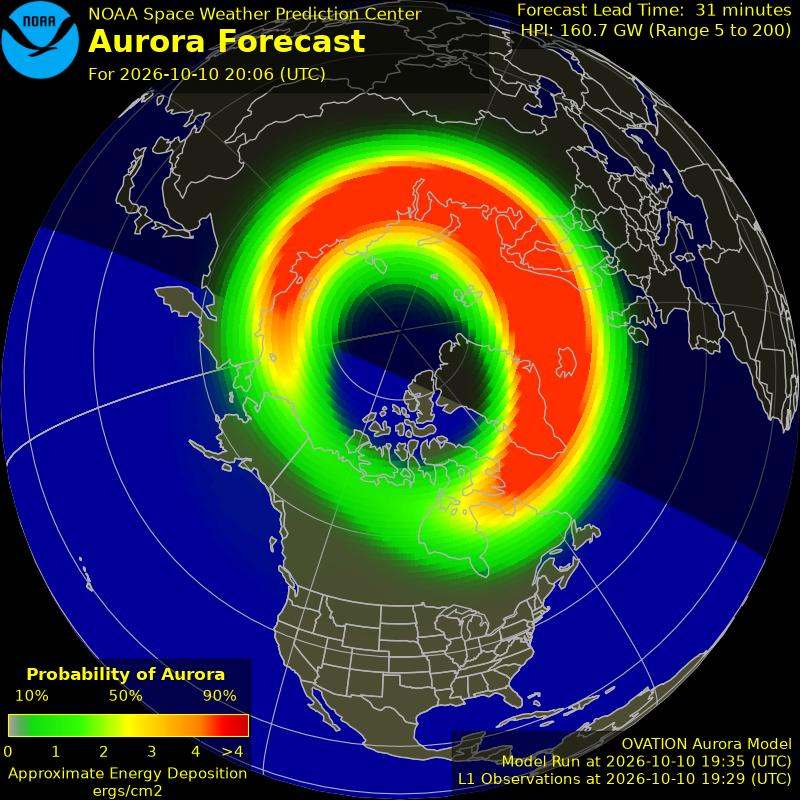
Who can see the northern lights tonight
NOAA's scale says that during a G3 storm, aurora may be seen as low as Illinois and Oregon. What you'll actually see depends on whether it's dark where you are while the storm is strong.
Europe: it's dark now
At 19:45 UTC it is 20:45 in the UK and Ireland, 21:45 in Central Europe and 22:45 in Finland. Europe is right under the storm in the evening, and the hours around local midnight are usually the most active.
- Overhead or high in the sky: Iceland, Norway, Sweden, Finland, the Baltic states and Scotland.
- Clearly visible to the north: Ireland, northern England and Wales, Denmark and the north of Germany and Poland.
- Possible low on the northern horizon, best by camera: southern England, the Netherlands, Belgium and central Germany, if the storm stays at Kp 7 or rises.
North America: it depends on the next few hours
The storm peaked during daylight in the Americas: 13:58 EDT and 10:58 PDT for the first Kp 7. Darkness arrives around 23:00 UTC on the East Coast and about 02:00 UTC on the West Coast. The CME is still passing, the field is still strong and more CMEs are on the way, so the chances are real but not guaranteed.
- If storming continues past dusk: all of Canada, Alaska and the northern states from Washington to Maine get a good show. Oregon, Idaho, Wyoming, South Dakota, Nebraska, Iowa, Illinois, Indiana, Ohio, Pennsylvania and New York are in range, mostly low in the north and best by camera.
- If it fades to G1–G2: the northern tier of states and Canada are still in play. See our weekend outlook for the G1–G2 visibility guide.
Southern Hemisphere
It's morning in Australia and New Zealand, so the aurora australis will only be visible there if the storm persists into their evening (from about 08:00 UTC on 11 October). Tasmania, Victoria and the South Island of New Zealand would then be best placed.
For photos, our iPhone and Samsung camera settings guide has a cheat sheet you can set up before you leave. If you're using a camera, see aurora photography settings for beginners. Faint aurora far south of the oval often looks colorless to the eye. Here's why.
Why the forecast said G1 and we got G3
At 12:30 UTC today, two hours before the shock, NOAA's 3-day forecast expected a maximum Kp of 4.67 for 10 October. That isn't a failure. It's the normal limit of CME forecasting:
- Arrival time is modeled from coronagraph images of the CME leaving the sun. Errors of ±6–12 hours are normal. This one came in roughly a day early, which suggests it was faster than the models estimated.
- Strength depends mostly on the CME's magnetic orientation. That can't be measured until the CME reaches the L1 monitor, 30–60 minutes before it hits Earth. This CME's field turned firmly south, and that turned a moderate event into a strong one.
The lesson: a storm watch means "be ready". Real-time Bz, not the 3-day forecast, tells you when to go outside.
What happens next
- Tonight (10 Oct UTC): NOAA's K7 warning runs until 23:59 UTC. The CME's magnetic structure is still passing, so more bursts of activity are possible whenever Bz dips south. Update: it did stay at storm level all evening, with Kp 6.67 for 18–21 UTC and 5.33 (G1) for 21–24 UTC.
- 11 October: NOAA's latest scales still show G2 for tomorrow. Other CMEs that left the sun on 7–9 October are still on their way, and a coronal-hole high-speed stream is adding to the disturbance.
- 12 October: the morning forecast called for G1–G2 on 12 October. That forecast was issued before today's arrival and is likely to be revised.
- Wildcard: Region 4549 fired an M6.4 flare at 15:10 UTC today, with a radio burst suggesting a shock at about 929 km/s. The region is now near the sun's western edge (N08W50), so any CME it launched would probably only hit Earth a glancing blow. Update: NOAA's analysis has the CME (first seen in coronagraph images at 15:48 UTC) passing just ahead of Earth, with only a possible graze late on 12 October.
Wider effects so far match a G3 storm: possible voltage corrections on high-latitude power grids, increased satellite drag and intermittent HF radio and GPS problems near the auroral zone. The two M6 flares also caused short R2 radio blackouts on the sunlit side of Earth. NOAA has reported nothing beyond normal G3 impacts.
The rest of the month, including the Kp 5 windows around 21–23 October and Halloween, is covered in our northern lights forecast for October 2026. This week's storms fit the pattern we describe in Northern Lights in 2026 and 2027: the declining phase of the solar cycle still delivers strong storms.
How to follow the storm live
- Our space weather bar at the top of this page shows the live NOAA Kp, solar wind speed and Bz.
- Aurora webcams under the oval show what the sky is doing right now in Finland, Norway, Iceland, Canada and Alaska. See our live aurora webcams page.
- NOAA SWPC publishes alerts, the real-time solar wind and the 30-minute OVATION aurora map.
- The UK Met Office issues space weather and aurora updates for the UK and Europe.
Frequently asked questions
Is there a geomagnetic storm today, 10 October 2026?
Yes. A CME shock reached the upstream monitor at 14:34 UTC, and NOAA issued K-index 7 alerts at 17:58 and 19:27 UTC. That is a strong G3 storm on the NOAA scale.
Where can you see the northern lights during a G3 storm?
NOAA says as low as Illinois and Oregon in the US. In Europe, overhead in Scotland and Scandinavia, and low in the north from England, Ireland, the Netherlands, northern Germany, Denmark and Poland, if it's clear and dark.
Will the northern lights still be visible tonight in North America?
Possibly. The peak came in daylight there, so it depends on Bz turning south again after dark. The CME was still passing at 19:35 UTC with a 20 nT field, and more CMEs are due on 11 October. Watch Bz and the NOAA aurora map from dusk.
Why did the forecast say G1 when the storm reached G3?
The CME arrived about a day early, and its magnetic field pointed strongly south. That orientation is only measurable 30–60 minutes before impact, so no 3-day forecast can know it in advance.
References
- NOAA Space Weather Prediction Center, Alerts, watches and warnings (K-index 5, 6 and 7 alerts, sudden impulse and X-ray event summaries, 8–10 October 2026).
- NOAA SWPC, Real-time solar wind (1-minute L1 plasma and magnetic field data).
- NOAA SWPC, Planetary K-index.
- NOAA SWPC, 3-Day Forecast and Forecast Discussion, issued 2026-10-10 12:30 UTC; follow-up Forecast Discussion issued 2026-10-11 00:30 UTC (CME attribution, M6.4 CME analysis).
- NOAA SWPC, Aurora – 30 Minute Forecast (OVATION model).
- NOAA SWPC, NOAA Space Weather Scales (G3 impacts and aurora visibility).
- WDC for Geomagnetism, Kyoto, Real-time (quick-look) Dst index.
- Press News Agency, Northern Lights spotted over UK skies (10 October 2026; sightings reported on social media, Aurora Watch UK red alert).
- Friends of NASA, Multicolored northern lights over Finland (Karsten Berger, Levi, 10 October 2026).
- EarthSky, Sun news: activity high after a powerful M flare (October 2026).
- BBC Sky at Night Magazine, Northern Lights forecast, 8–11 October 2026.
- UK Met Office, Space weather forecast.