Update, 10 Oct 19:45 UTC: the 10–12 October storm arrived early and reached G3 (Kp 7). See strong G3 geomagnetic storm underway for live data and where to look tonight.
Forecast basis: NOAA SWPC's 3-day forecast (issued 10 Oct, 12:30 UTC) and 27-day outlook (issued 5 Oct). Long-range outlooks are updated every Monday, and individual storms can only be forecast one to three days ahead. Use this as a planning guide, then check the live forecast on the night.
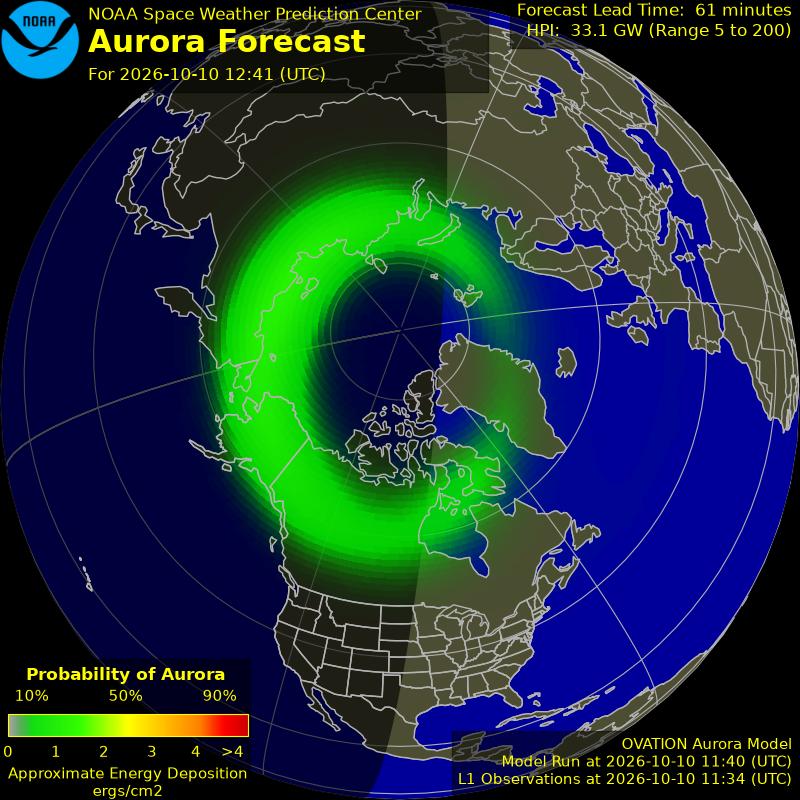
- 10–12 Oct: G1–G2 storm conditions forecast (Kp up to 5.67) under a new moon. The best window of the month.
- 21–23 Oct: Kp 5 forecast. The moon is waxing gibbous, so the darkest skies come after it sets. The Orionid meteor shower peaks around the same time.
- 31 Oct: Kp 5 forecast, the month's most disturbed day in NOAA's outlook. A possible Halloween aurora.
- Quiet spells (13–20 Oct and 24–30 Oct, full moon 26 Oct): aurora mostly limited to high latitudes.
October is one of the best months of the year for the northern lights. Nights are long again across Scandinavia, Iceland, Alaska and Canada, lakes are still unfrozen for reflections, and the weeks after the September equinox bring geomagnetic storms more often than midwinter does. (We explain that equinox effect in our guide to the best time to see the northern lights.)
What's driving aurora activity in October 2026?
The sun is in the declining phase of Solar Cycle 25, which peaked in late 2024. Sunspot numbers are falling, but this phase of the cycle is known for frequent geomagnetic storms, from two sources that are both active this month (see Northern Lights in 2026 and 2027 for the background):
- Coronal mass ejections (CMEs). Several CMEs launched earlier this week are due to arrive between 10 and 12 October. NOAA also flags active sunspot Region 4549 as capable of further M-class flares, so more eruptions are possible.
- Coronal hole high-speed streams. Fast solar wind from coronal holes returns roughly every 27 days as the sun rotates. October opened with a G2 storm on 4 October (Kp 5.67), and NOAA's outlook expects disturbed conditions again on 31 October, exactly one solar rotation later. That's the signature of a recurring stream.
October 2026 aurora forecast, day by day
The chart combines what has already happened this month with NOAA's latest forecasts. The dashed line marks Kp 5, the threshold for a G1 geomagnetic storm, which is roughly when the aurora becomes visible from Scotland, southern Scandinavia and the northern US.
| Dates | Expected activity | Moon | Outlook |
|---|---|---|---|
| 1–9 Oct | Observed: G2 storm on 4 Oct (Kp 5.67), Kp 5.33 on 5 Oct, then quiet | Waning | Past |
| 10–12 Oct | G1 late on 10 and 11 Oct, G1–G2 early on 12 Oct (UTC) | New moon 10 Oct | Excellent |
| 13–20 Oct | Kp 2–3, quiet to unsettled | Waxing crescent, first quarter 18 Oct | High latitudes only |
| 21–23 Oct | Kp 5 forecast on 21–22 Oct, Kp 4 on 23 Oct | Waxing gibbous | Good, after moonset |
| 24–30 Oct | Kp 2–3, quiet | Full moon 26 Oct | High latitudes only |
| 31 Oct | Kp 5 forecast, highest planetary A index of the month (30) | Waning gibbous | Good, early evening |
Kp values are NOAA's forecast daily maximums (3-hour Kp). Dates are UTC.
Best days to see the northern lights in October 2026
10–12 October: storm watch under a new moon
This is the standout window. NOAA expects G1 (minor) storming late on 10 and 11 October and G1–G2 (minor to moderate) early on 12 October, as several CMEs arrive with help from a coronal hole stream. The new moon on 10 October means no moonlight at all. In Europe, the strongest period falls in the small hours of Monday 12 October. In North America, it falls on the evening of Sunday 11 October. Our weekend storm watch has the full breakdown.
21–23 October: a recurring stream, plus the Orionids
NOAA's 27-day outlook forecasts Kp 5 on 21 and 22 October, with a planetary A index of 22 on the 22nd, typical of a recurring coronal hole stream. The moon will be waxing gibbous, bright in the evening and setting after midnight, so the darkest skies come in the hours before dawn. As a bonus, the Orionid meteor shower peaks around 21–22 October, so you may catch meteors and aurora in the same pre-dawn sky.
31 October: a possible Halloween aurora
The outlook's most disturbed day is 31 October: Kp 5 and a planetary A index of 30, the highest value in the table. It lines up with the return of whatever drove the 4–5 October storm. The moon is waning gibbous and rises late in the evening, so the early evening hours will be darkest. Because this is 21 days out, treat it as a date to watch rather than a promise.
Moon phases in October 2026
| Phase | Date (UTC) | What it means for the aurora |
|---|---|---|
| New moon | 10 October | Darkest skies of the month, coinciding with this weekend's storm watch. |
| First quarter | 18 October | The moon sets around midnight, leaving dark skies in the early morning hours. |
| Full moon | 26 October | Bright all night. Only strong displays stand out, though moonlit landscapes photograph beautifully. |
| Last quarter | 1 November | The moon rises around midnight, leaving dark skies in the evening. |
Moonrise and moonset times vary with your latitude. Check a local almanac. More on why it matters in moonlight and light pollution.
Where to see the northern lights in October 2026
On quiet nights you need to be under the auroral oval. During the forecast storm windows, the aurora can reach much farther south:
- Tromsø and Lofoten, Norway: right under the oval. October's unfrozen fjords give mirror-like reflections.
- Abisko, Sweden and Finnish Lapland: inland and often clearer than the coast, with aurora on most clear nights.
- Iceland: dark skies a short drive from Reykjavík, though October can be cloudy, so stay flexible.
- Fairbanks, Alaska and Yellowknife, Canada: dry interior air and some of the most reliable viewing in North America.
- Scotland, southern Scandinavia and the northern US: realistic during the G1–G2 windows (10–12 and 21–23 October). Look low toward the northern horizon, away from town lights.
For more on destinations and seasons, see the best places to see the northern lights.
Tips for October aurora hunting
- Mind the clock change. Europe moves clocks back on 25 October and North America on 1 November, so peak aurora hours (around magnetic midnight) shift an hour earlier on the clock.
- Watch Bz on the night. A CME only produces a strong display if its magnetic field turns south. Real-time solar wind data gives about 30–60 minutes' warning. See reading the Kp index.
- Use a red light. White light resets your night vision. Faint aurora may look grey to the eye anyway, as explained in can you see the northern lights with the naked eye?
- Bring a camera, even a phone. A 3–10 second exposure reveals color the eye can't. Start with our aurora photography settings, or the iPhone and Samsung settings.
- Chase clear skies. Cloud cover decides more October nights than Kp does. Check short-range cloud forecasts and be ready to drive.
How reliable is a monthly aurora forecast?
Honestly, only partly. NOAA's 27-day outlook is built largely on the sun's 27-day rotation: if a coronal hole caused a disturbance last rotation, it predicts a repeat. That works surprisingly often for recurring streams, but it can't foresee new eruptions, and coronal holes change shape or fade. Forecasts for individual CMEs only become possible once the eruption is seen leaving the sun, usually one to three days ahead. Even then, the storm's strength depends on its magnetic orientation, which can only be measured about an hour before it hits.
So use the dates in this article to plan where and when to be ready, and the 3-day forecast and live solar wind data to decide whether to head out.
Frequently asked questions
Will there be northern lights in October 2026?
Yes. A G2 storm already occurred on 4 October. NOAA forecasts G1–G2 conditions for 10–12 October and Kp 5 on 21–22 and 31 October. At high latitudes, aurora is likely on most clear, dark nights.
What is the best night to see the northern lights in October 2026?
The night of 11–12 October: Kp up to 5.67 is forecast early on 12 October UTC, right after the new moon. Next best are 21–23 October (after moonset) and 31 October (early evening).
Can you see the northern lights on Halloween 2026?
Possibly. NOAA's 27-day outlook forecasts Kp 5 on 31 October, likely a recurring stream. It's a long-range forecast, so check the 3-day forecast nearer the date.
What Kp do I need to see the northern lights?
Kp 2–3 is often enough under the auroral oval. Scotland, southern Scandinavia and the northern US usually need Kp 5 or more, and central Europe or the central US Kp 7 or higher.
The bottom line
October 2026 has a strong start, with a G2 storm on the 4th and a storm watch for 10–12 October under a new moon, plus two more promising windows around 21–23 October and Halloween. Pick a dark spot, check the forecast each afternoon, and give yourself a few nights. Stuck indoors or under cloud? Check the live aurora webcams to see what the sky is doing in Lapland, Iceland or Alaska right now. We'll publish the November 2026 forecast at the end of the month.
References
- NOAA Space Weather Prediction Center, 3-Day Forecast, issued 2026-10-10 12:30 UTC.
- NOAA SWPC, 27-Day Outlook of 10.7 cm Radio Flux and Geomagnetic Indices, issued 2026-10-05.
- NOAA SWPC, Planetary K-index (observed values, 3–10 October 2026).
- NOAA SWPC, Aurora Dashboard.
- NASA Science, Orionids.
- Catalina Sky Survey / University of Arizona, Moon phases, October 2026.