- The solar wind is measured only about an hour before it reaches Earth. Anything further ahead is an educated guess, however precise the numbers look.
- Kp is a three-hour, planet-wide average. A "Kp 5 night" can be quiet for the two hours you're outside, and a "Kp 3 night" can have a 20-minute burst overhead.
- CME arrival times are typically off by around 10 hours or more, in either direction. A storm forecast for your evening can easily land in your daytime.
- No space-weather forecast knows about your clouds or the moon. That's a separate check, and often the one that decides the night.
A miss from this week
We'll start with a real one, because it happened while we were writing this. On the morning of 27 November 2026, NOAA's 3-day forecast expected a minor G1 storm that day, with Kp reaching 4.67 in the 15:00–18:00 UTC slot as a coronal hole stream arrived. By the evening, the observed Kp had stayed between 0.33 and 2 all day. The stream was late, weaker than expected, or both.
That doesn't mean NOAA's forecasters did a bad job. Their forecast said "likely", the physics behind it was sound, and the same kind of forecast was spot on, or too cautious, several times this autumn (see how our November dates turned out). It's simply what space-weather forecasting looks like today. The useful question isn't "was the forecast right?" but "what could it actually know, and when?"
Four kinds of aurora forecast, four levels of certainty
Most confusion comes from treating every forecast as the same thing. They aren't. Roughly from least to most reliable:
| Forecast | How far ahead | What it's based on | How to use it |
|---|---|---|---|
| 27-day outlook | 1–4 weeks | Coronal holes recurring every solar rotation | Pick which week to keep free. Never book around one night. |
| 3-day forecast | 1–3 days | Coronal holes and CMEs seen on the Sun, plus models | Decide which nights are worth planning for. |
| Live solar wind | 30–60 minutes | Satellites measuring the wind before it reaches Earth | Decide whether to go out now. |
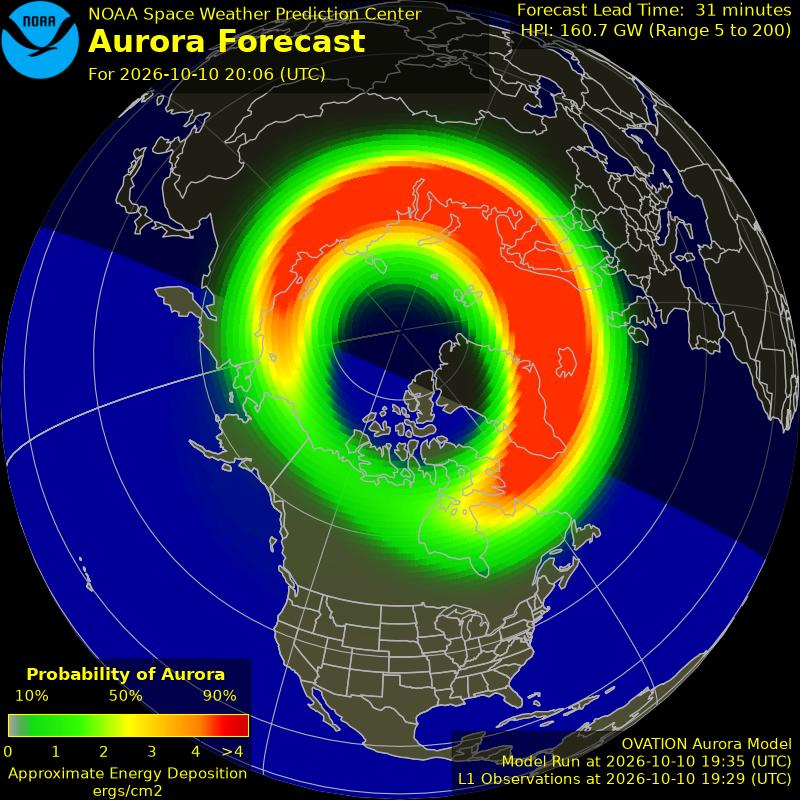
| OVATION nowcast | About 30–90 minutes | A model driven by the live solar wind | See where the oval is right now, and how bright. |
A good rule: the further ahead a forecast looks, the more it should change which nights you keep free and the less it should change whether you get in the car.
The one-hour problem
The aurora is driven by the solar wind, the stream of charged gas flowing off the Sun. The only direct measurements we have come from a handful of spacecraft parked about 1.5 million kilometres sunward of Earth, at a point called L1. The solar wind usually travels at 300 to 800 km/s, so it takes roughly 30 to 80 minutes to get from those spacecraft to us.
That's the honest lead time for knowing what the solar wind will do at Earth. Everything beyond that hour is inferred from pictures of the Sun and from models. Some of those models are very good, but they can't measure the thing that matters most until it's almost here. When a forecast a day ahead looks precise to two decimal places, the precision is in the arithmetic, not in our knowledge.
Why Kp misleads people
Kp is the number everyone quotes, so it's worth knowing what it is. It's a planetary index built from magnetometers around the world, and each value covers a three-hour block. It was designed to describe how disturbed Earth's magnetic field was, not to tell you what you'll see from a lake in Finland at 10:40 pm.
Two things follow from that:
- The aurora comes in bursts. Much of the best aurora comes from substorms, sudden brightenings that often last 15 to 30 minutes. A three-hour block with Kp 5 can contain one big substorm and two hours of a faint arc. If you were in the car for the substorm, you missed it.
- Kp is global; your sky is local. A storm can be strongest over North America while Europe is in daylight, or the other way round. Kp doesn't say where.
Kp is still a useful guide to how far south the aurora might reach, which is how we use it in our Kp index guide. Just don't read it as a promise for a particular hour.
Why storm arrival times slip
The biggest storms come from coronal mass ejections (CMEs), huge clouds of solar material thrown out by eruptions. Forecasters see them leave the Sun, estimate their speed and direction from coronagraph images, and model their trip across 150 million kilometres. The results are impressive, but not precise. A study of the international CME Scoreboard (Riley and colleagues, 2018) found that even the best models had a typical arrival-time error of around 13 hours, with no clear improvement over the five years studied. Newer methods do a little better, but errors of 10 hours or more are still normal.
That's why a CME "due on Saturday evening" can arrive Saturday morning, or Sunday lunchtime. If you're on the wrong side of the planet when it hits, you'll see the tail end or nothing. It's also why a storm can show up with little warning: a CME that was expected to be a glancing blow sometimes hits more squarely than modelled.
Bz: the coin flip nobody can call in advance
Even when a solar wind stream or CME arrives right on time, the aurora depends heavily on the direction of its magnetic field. Scientists call the north–south part of it Bz. When Bz points south, the solar wind's field links up with Earth's and energy pours in. When it points north, a fast, dense solar wind can pass by with surprisingly little aurora.
There is currently no reliable way to know Bz until the wind reaches L1, about an hour before it reaches us. A storm that "fizzles" has usually had a northward Bz. A surprise display on a quiet forecast has usually had a southward Bz that held for an hour or two. If you watch just one live number on the night, make it Bz, on our northern lights tonight page or anywhere else that shows it.
The part that isn't space weather
Here's the part that catches out most people, and it has nothing to do with the Sun. Space-weather forecasts tell you about the aurora. They know nothing about whether you can see it:
- Cloud. The most common reason for a missed aurora. A G2 storm behind solid overcast is invisible. Check the hourly cloud forecast, and specifically low and mid-level cloud.
- Darkness. Twilight at high latitudes lasts a long time. In early autumn and spring, it may not be dark enough until late.
- The moon. A bright moon high in the sky drowns out faint aurora. See how moonlight and light pollution affect what you see.
- Your eyes. Faint aurora often looks like grey cloud to the eye. Your phone camera will see the green first. More in can you see the northern lights with the naked eye?
- Your view north. Further south, the aurora sits low on the northern horizon. A town, a hill or a line of trees in the way is enough to hide it.
Why aurora apps disagree with each other
Open three aurora apps and you'll often see three different answers. Usually it isn't because one is broken. They show different things: one shows the Kp forecast, one the OVATION probability for your location, one a homemade score. Some update every few minutes, others every few hours. Some include clouds and many don't.
That's the problem we set out to fix with Moose, and we'd rather explain it than ask you to trust a number. Our visibility score multiplies NOAA's OVATION probability for your location by a cloud-cover factor and accounts for darkness. The full method, including where it can go wrong, is in how the Moose visibility score works. Whatever app you use, it's worth knowing what's behind its number.
How to decide whether to go out tonight
This is the routine we'd suggest. It takes two minutes and gets more useful the closer you get to the night.
- Days ahead: look at the 3-day forecast. Kp 4 or more (or Kp 2–3 if you're in the Arctic) means keep the evening free. Don't decide anything else yet.
- Afternoon: check the cloud forecast for your area and one or two places you could drive to. If it's overcast everywhere, it's a night in, whatever the Kp.
- After dark: look at the live solar wind. Bz south (negative) for more than about 15 minutes, ideally −5 nT or lower, with speed above about 450 km/s, is a good sign. Bz north for hours is a bad one.
- When Bz turns south: go out. Activity often follows within 30 to 60 minutes. Give your eyes 20 minutes to adjust, and use your phone camera to check for faint colour.
- If nothing happens: come back in and keep checking. A quiet first half of the night doesn't say much about the second.
Or let something do the checking for you. That's what aurora alerts are for, provided they look at cloud and darkness as well as Kp.
Free printable card. The routine above, with the numbers to look for, on the Aurora Go/No-Go Card (PDF, 2 pages). Save it to your phone or stick it on the fridge.
Sources
- NOAA SWPC, 3-Day Forecast issued 27 November 2026 12:30 UTC, and daily geomagnetic indices (observed Kp, 27 November 2026).
- Riley, P. et al. (2018), Forecasting the Arrival Time of Coronal Mass Ejections: Analysis of the CCMC CME Scoreboard, Space Weather 16, 1245–1260.
- NOAA SWPC, Aurora 30-minute forecast (OVATION) and real-time solar wind.
- Aurorasaurus, substorms and magnetic midnight.

Frequently asked questions
Why didn't I see the northern lights when the forecast said Kp 5?
Usually for one of four reasons: cloud; the storm arrived earlier or later than forecast; the solar wind's magnetic field (Bz) pointed north, so little energy reached Earth; or the activity came in short bursts while you weren't looking. Kp is a three-hour global average, not a promise for your sky at a particular time.
How accurate are aurora forecasts?
It depends on how far ahead they look. Live solar wind data gives a reliable picture about 30 to 60 minutes ahead. One- to three-day forecasts are good at saying which nights are likely to be active but often miss timing and strength. Forecasts of CME arrival are typically off by around 10 to 13 hours. 27-day outlooks only show which weeks may be active.
What is the most reliable way to know if the aurora is out right now?
Watch the live solar wind, especially Bz, plus NOAA's OVATION 30-minute forecast map, and check the cloud forecast for your location. A southward Bz that holds for 15 minutes or more is the best short-term sign that activity is coming.
Can the northern lights appear when the forecast is low?
Yes. If the solar wind's magnetic field turns south and stays there, a quiet forecast can turn into a good display at short notice. In the Arctic, under the auroral oval, aurora is common even at Kp 1 to 3.
Why do aurora apps show different forecasts?
They show different things: some show the Kp forecast, some NOAA's OVATION probability for your location, some their own scores, and only some include cloud cover and darkness. They also update at different rates. Check what each app's number is based on.