- Best odds: the far north. FMI statistics put the aurora on about three clear, dark nights in four around Kilpisjärvi and Utsjoki, against roughly one in two around Levi, Saariselkä and Rovaniemi.
- Easiest trip: Rovaniemi, with the most flights, a night train from Helsinki and plenty to do by day. You trade a little aurora probability for convenience.
- Best balance: Saariselkä or Inari. Higher odds than Rovaniemi, real darkness, and Ivalo airport 30–40 minutes away.
- Stay at least four nights. Cloud, not the Sun, is what usually ruins a short trip.
How often you actually see the northern lights in Lapland
The most useful number here comes from the people who measure it. The Finnish Meteorological Institute (FMI) runs magnetometers and all-sky cameras across Lapland, and its statistics say that on a dark, clear night the aurora appears on about 75% of nights around Kilpisjärvi in the far north-west, and on roughly half of nights around the ski resorts such as Levi, Ylläs and Saariselkä. Further south in central Finland it drops to about a quarter.
Notice the condition: dark and clear. Those odds are per clear night, not per night of your trip. A week of solid cloud gives you zero no matter where you are, which is why the advice at the end of this guide is mostly about staying flexible.
The other thing these numbers hide is strength. Around Kilpisjärvi or Utsjoki, the auroral oval is often right overhead and even a quiet night (Kp 1–2) can put a band across the sky. Around Rovaniemi you more often see it to the north, and it takes a slightly more active night to get it overhead. Our Kp index guide explains why latitude matters so much.
The five main bases compared
| Base | Aurora odds (clear night) | Nearest airport | Polar night* | Best for |
|---|---|---|---|---|
| Rovaniemi | About 1 in 2 | Rovaniemi (RVN), in town; night train from Helsinki | None; about 2 h of sun at the solstice | Short trips, families, daytime activities |
| Levi | About 1 in 2 | Kittilä (KTT), ~15 min | 12 Dec – 1 Jan | Skiing plus aurora, lively village |
| Saariselkä | About 1 in 2, often better | Ivalo (IVL), ~30 min | 6 Dec – 7 Jan | Wilderness feel, aurora cabins, fell walks |
| Inari | Between Saariselkä and the far north | Ivalo (IVL), ~40 min | 3 Dec – 10 Jan | Dark lake views, Sámi culture, quiet |
| Kilpisjärvi | About 3 in 4 | Enontekiö or Tromsø, both ~2.5–3 h by road | 2 Dec – 11 Jan | Maximum odds, fell scenery, few people |
Aurora odds from FMI statistics for dark, cloud-free nights. *Days with no sunrise above a flat horizon, from our own calculation for winter 2026–27; hills and fells extend it locally. Travel times are approximate.
Rovaniemi: the convenient choice
Rovaniemi sits right on the Arctic Circle and is the gateway most people use. It's a real town of around 65,000 people, which cuts both ways. You get restaurants, the Arktikum science museum, Santa Claus Village, and flights from much of Europe in winter. You also get street lights, so you'll want to get out of the centre to watch: a short drive or a tour to a lake or the fells outside town makes a big difference.
Rovaniemi never has a true polar night. Around the solstice the sun clears the horizon for about two hours, rising after 11:00 and setting before 13:30. That bit of daylight is welcome when you're doing husky or reindeer trips, and it doesn't cost you anything in darkness: it's properly dark from mid-afternoon.
Choose it if: you have three or four nights, you're travelling with kids, or you want a mix of things to do and a reasonable aurora chance rather than the best possible one.
Levi: skiing and aurora in one trip
Levi is Finland's biggest ski resort and about 15 minutes from Kittilä airport, which has direct winter flights from several European cities. It's further north than Rovaniemi and the odds are similar or a little better, but the resort village itself is bright. Walk or drive a few kilometres out, to a lake or a quiet road, and the sky opens up. Note that private fireworks are banned in the village centre over New Year.
Levi has a short polar night, about three weeks around the solstice. If you're skiing, that's worth knowing: the slopes are floodlit, but the landscape looks very different in blue twilight.
Choose it if: someone in your group wants to ski, or you like a resort with nightlife and plenty of choice.
Saariselkä: our pick for most people
Saariselkä is a small fell village on the edge of Urho Kekkonen National Park, half an hour from Ivalo airport. It's compact enough that dark sky is a ten-minute walk away, and this is where you'll find many of the glass-roofed aurora cabins. Kiilopää fell nearby gives you a big open sky above the tree line.
On paper the FMI odds are similar to Levi, but Saariselkä sits nearly a degree further north, so on an average night the aurora is higher in the sky. It has a real polar night from early December to early January.
Choose it if: you want the wilderness feel without a long transfer, and you'd rather spend your evenings outside than in a bar.
Inari: the quiet, dark one
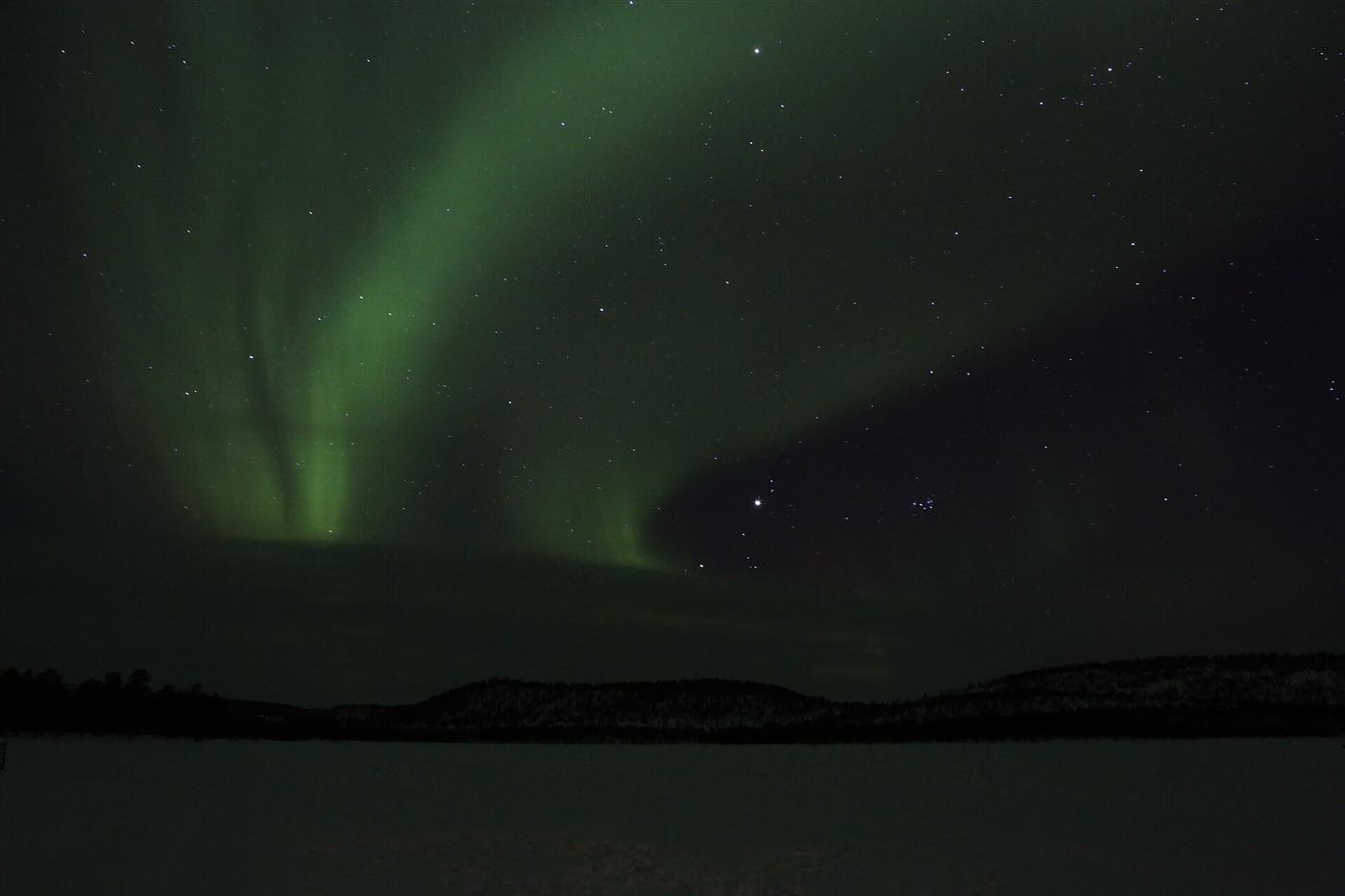
Inari is a small village on the shore of Lake Inari, Finland's third-largest lake, and it's the centre of Sámi culture in Finland. Siida, the Sámi museum and nature centre, is excellent and worth a full afternoon. At night, the frozen lake gives you a horizon-to-horizon view with almost no light pollution.
There's less to do here than in the resorts, and that's the point. It's further north than Saariselkä, so the odds are better again, and the polar night runs from early December to around 10 January.
Choose it if: you're happy with a quiet base, and you care about the culture and the place as much as the lights.
Kilpisjärvi: the best odds in Finland
Kilpisjärvi is in the "arm" of Finland, squeezed between Sweden and Norway, among the country's highest fells. It's the place behind FMI's three-in-four figure. The auroral oval is very often directly overhead, so even quiet nights tend to deliver. It's also remote: a small village, a few places to stay, and the nearest airports a two-and-a-half to three hour drive away (Enontekiö in Finland, or Tromsø in Norway).
It's a great place for people who've seen weak aurora before and want a big display, or for photographers who want Saana fell or the frozen lake in the foreground. In midwinter it's very dark (polar night from early December to mid-January), and very cold.
Choose it if: the aurora is the whole point of the trip, you're comfortable driving on snow, and you have five nights or more.
Daylight and polar night in Lapland
"Polar night" sounds like 24-hour pitch black. It isn't. Even on the solstice there are several hours of deep blue twilight around midday, plenty for a husky ride or a walk. Here is how much actual sunlight you get, from our own calculations for this winter:
| Place | 1 December | 21 December | 15 January |
|---|---|---|---|
| Rovaniemi | 3 h 48 min | 2 h 15 min | 4 h 11 min |
| Levi | 2 h 44 min | No sunrise | 3 h 16 min |
| Saariselkä | 1 h 59 min | No sunrise | 2 h 41 min |
| Inari | 59 min | No sunrise | 2 h 05 min |
| Kilpisjärvi | 20 min | No sunrise | 1 h 53 min |
Sun above a flat horizon, calculated by Moose. Local hills often hide a low sun completely.
For aurora watching, what counts is the 14 to 15 hours a day when the sky is properly dark, which every one of these places gets from November to January. You don't need to stay up all night: the aurora is often visible from the early evening.
Which month to go
- Late August to September: nights are dark again, lakes aren't frozen, and you get autumn colours (ruska) by day. Activity tends to be a little higher around the equinox. Not cold.
- October to November: often the cloudiest stretch, with snow arriving. Fewer visitors and lower prices.
- December to January: polar night, deep snow, very cold, and Christmas crowds in Rovaniemi. Long dark nights mean more hours to catch a display. See our December forecast and New Year's Eve outlook.
- February to March: many people's favourite. Days are getting longer, it's often clearer and calmer, and the March equinox tends to bring more activity. Still very cold at night.
The full reasoning on months and years is in our best time to see the northern lights guide.
How many nights, and car or tours?
Four nights is the minimum we'd suggest, five or more is better. The FMI odds are good, but Lapland weather systems can park cloud over the whole region for two or three days. A longer stay gives you a better chance of at least one clear night with activity.
Then there's the car-or-tour question:
- Aurora tours (minibus or snowmobile) are good value for a first trip. The guides know where the clear gaps are, they carry warm suits and hot drinks, and many help with photos. The downside is a fixed start time.
- A rental car lets you chase gaps in the cloud on your own schedule and come back when you like. Winter roads in Lapland are well kept, cars come with studded or winter tyres, and reindeer on the road are a real hazard, especially in the dark.
- Neither: stay somewhere with dark sky outside the door (Saariselkä, Inari and Kilpisjärvi are all good for this) and use an aurora alert. Many hotels also offer an "aurora alarm" call or text.
Whichever you choose, check the cloud forecast as well as the aurora forecast every afternoon. On cloudy nights, an hour's drive can be the difference between nothing and a clear sky. Live data for any location is on our northern lights tonight page, and FMI publishes its own real-time magnetometer readings for Lapland stations.
The cold, honestly
Inland Lapland in midwinter regularly sits at −15 to −25 °C at night, and most winters bring a few nights colder than −30 °C. It's a dry cold, and with the right clothes it's fine, even pleasant. Without them, standing still for an hour looking up is miserable. The basics:
- Merino or wool base layer, top and bottom, and a fleece or down mid layer.
- Windproof outer layer. Many tours and some hotels lend thermal overalls; ask before you buy.
- Insulated winter boots rated well below zero, a size up for thick wool socks.
- Mittens over thin liner gloves, so you can work a phone or camera without freezing your fingers.
- A hat that covers your ears, a buff or scarf, and hand warmers.
- A spare phone battery or power bank in an inside pocket. Cold drains batteries very fast.
Phone photos work well in Lapland if you hold still. Our phone camera settings guide covers iPhone and Samsung.
Free printable planner. The Finnish Lapland Aurora Planner (PDF, 2 pages) has the base comparison, daylight table, a nightly checklist and a cold-weather packing list, ready to print or keep on your phone offline.
Sources
- Finnish Meteorological Institute, Northern lights and Auroras in Finland (aurora frequency on clear nights by region).
- Visit Finland, The best times to see the northern lights.
- Levi, fireworks restrictions in Levi village.
- Daylight and polar night: calculated by Moose from standard solar position formulas.

Frequently asked questions
Where is the best place in Finland to see the northern lights?
For the highest odds, the far north: Kilpisjärvi and Utsjoki, where Finnish Meteorological Institute statistics show the aurora on about three in four dark, clear nights. Saariselkä and Inari are a good balance of odds and access, with Ivalo airport nearby. Rovaniemi and Levi are the easiest to reach, with the aurora on roughly every second clear night.
Can you see the northern lights in Rovaniemi?
Yes. Rovaniemi is on the Arctic Circle and sees the aurora on roughly half of dark, clear nights. Get out of the town centre to a lake, river bank or fell where street lights don't wash out the sky.
Is there polar night in Lapland?
In the north, yes. In winter 2026–27 the sun doesn't rise above a flat horizon in Levi from about 12 December to 1 January, in Saariselkä from 6 December to 7 January, in Inari from 3 December to 10 January and in Kilpisjärvi from 2 December to 11 January. Rovaniemi never has polar night and gets about two hours of sun at the solstice. Polar night still has several hours of blue twilight around noon.
How many nights do I need in Lapland to see the northern lights?
At least four, ideally five or more. The aurora is common in Lapland, but cloud can cover the region for several days, and a longer stay gives you more chances of a clear night.
What is the best month to see the northern lights in Finnish Lapland?
The season runs from late August to early April. September and March combine dark nights with slightly higher activity around the equinoxes. February and March are often clearer and calmer, and December and January have the longest nights. October and November tend to be cloudier.
How cold is Lapland in winter?
Nights in inland Lapland are often between −15 and −25 °C in December to February, and most winters have some nights below −30 °C. It is a dry cold, and with wool layers, a windproof outer layer, insulated boots and mittens it is comfortable for watching the sky.