Forecast basis: written on 27 November 2026. NOAA's 27-day outlook (issued 23 November) runs only to 19 December, so the 31 December date below is our projection, one 27-day solar rotation on from NOAA's forecast for 4 December. We will update this page when NOAA's outlook reaches the new year, and again a few days before.
- The case for it: the coronal hole that gave Kp 5.33 (G1) on 7–8 November is forecast by NOAA to bring Kp 5 again on 4 December. Another 27 days on is 31 December.
- The moon helps: it is at last quarter on New Year's Eve and doesn't rise until roughly 2–4 am across Lapland, Norway, Iceland, Scotland and Alaska. Midnight is moon-free.
- The catch: recurring streams drift by a day and change strength. Treat 30 December to 1 January as a window, not a date.
- The real enemies: cloud, and town lights plus firework smoke at midnight. Get 20 minutes out of town before 11 pm.
What are the chances of northern lights on New Year's Eve 2026?
Better than a random night, and here is why. The Sun rotates about once every 27 days as seen from Earth. When a long-lived coronal hole (a patch that lets fast solar wind escape) faces us, we get a few unsettled nights. When it lasts several rotations, the storms come back on a fairly reliable schedule.
This autumn one of those streams has done exactly that:
| Visit | Date | Strength | Source |
|---|---|---|---|
| 1 | 7–8 November | Kp 5.33 (G1) | Observed, NOAA |
| 2 | 4–5 December | Kp 5 then 4 | NOAA 27-day outlook |
| 3 | 30 Dec – 1 Jan | Unknown, possibly Kp 4–5 | Our projection |
Observed values from NOAA SWPC's daily geomagnetic indices. Forecast values from the 27-day outlook issued 23 November 2026.
We want to be straight about what that means. Coronal holes change shape. They shrink, merge and sometimes disappear between rotations, and the arrival can slip by a day either way. In our November track record two of three recurring storms came in stronger than expected and one arrived a day late. So: a decent chance of an active night somewhere between the 30th and the 1st, and no promise of one on the 31st itself.
There is also a wild card in either direction. A coronal mass ejection, the kind of eruption behind the big storms, can turn up with one to three days' notice and nobody can see it coming a month ahead. That's the main reason to keep checking in the days before (more on that in the plan).
The moon on New Year's Eve 2026
This part we can say with confidence, because it is just orbital mechanics. The December full moon is on 24 December. By New Year's Eve the moon is at last quarter, about half lit, and a last quarter moon rises around midnight on average. In the far north in winter, it rises later still. These are our own calculations for the night of 31 December into 1 January, in local time:
| Place | Moonrise (1 Jan) | Midnight sky |
|---|---|---|
| Tromsø, Norway | about 03:15 | Moonless |
| Abisko, Sweden | about 03:00 | Moonless |
| Rovaniemi, Finland | about 03:15 | Moonless |
| Saariselkä / Inari, Finland | about 03:30 | Moonless |
| Reykjavík, Iceland | about 04:25 | Moonless |
| Edinburgh, Scotland | about 02:25 | Moonless |
| Fairbanks, Alaska | about 04:30 | Moonless |
| Yellowknife, Canada | about 03:50 | Moonless |
| Minneapolis, USA | about 02:15 | Moonless |
Computed by Moose from standard lunar position formulas, rounded; your exact time varies by a few minutes with terrain and position.
A half moon low in the east isn't a disaster anyway, but a dark sky at midnight means faint aurora shows up as colour on camera and grey-green to the eye. For more on how much the moon matters, see why the moon can ruin your photos.
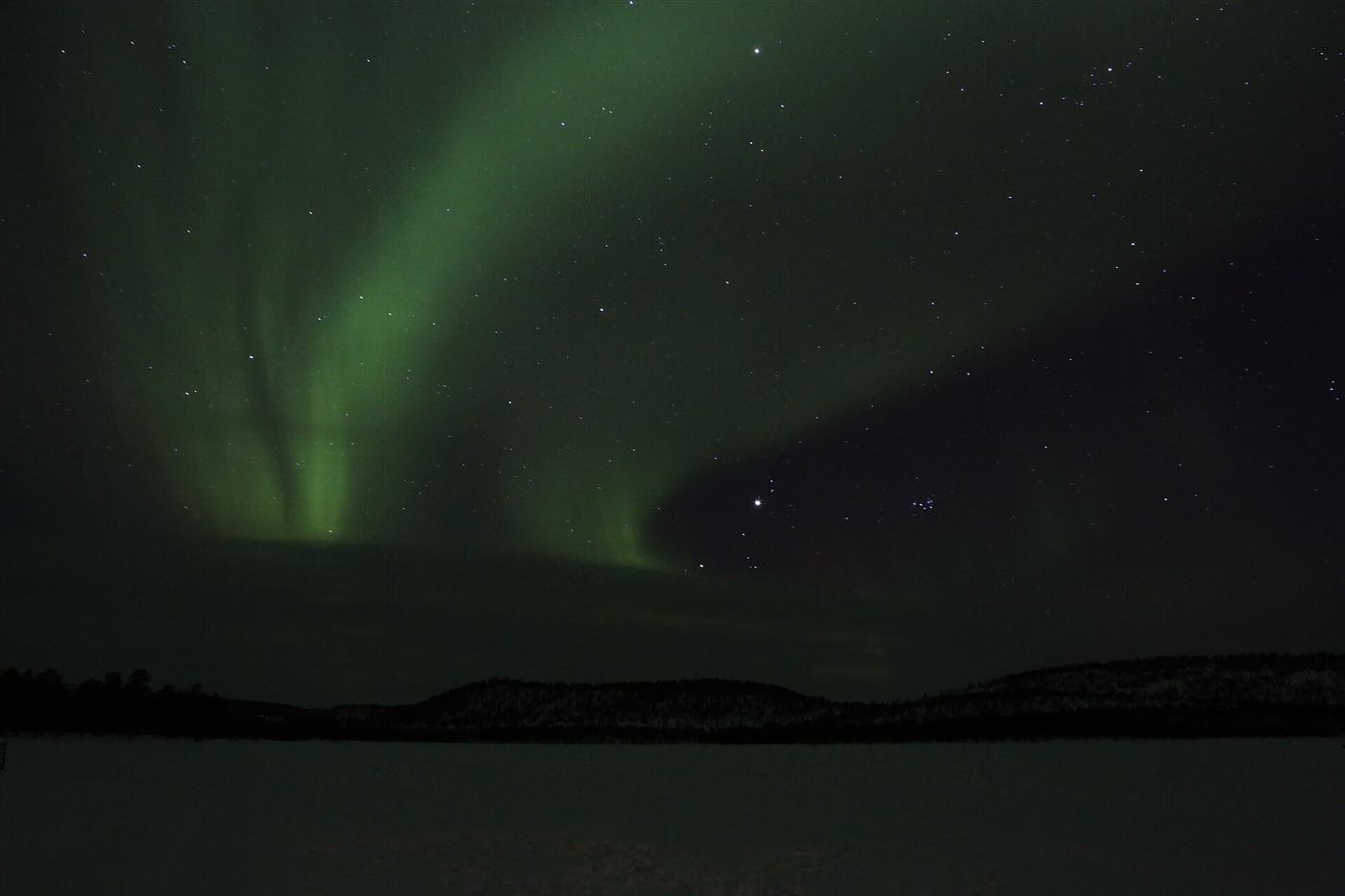
Where you could see the northern lights on New Year's Eve
It depends almost entirely on how strong the night turns out to be, so here it is by Kp level. If you're new to Kp, our guide to reading the Kp index explains it in five minutes.
- Any night, even Kp 1–3: northern Norway (Tromsø, Alta, Lofoten), Swedish Lapland (Abisko, Kiruna), northern Finnish Lapland (Kilpisjärvi, Inari, Saariselkä), Iceland, interior Alaska and northern Canada. Here the question is cloud, not activity.
- Kp 4: add Rovaniemi and Levi comfortably overhead, the Faroes, Shetland and Orkney low in the north, and southern Alaska.
- Kp 5 (G1): northern Scotland, and in the US the northern tier: Minnesota, North Dakota, Michigan's Upper Peninsula, northern Maine. Low on the northern horizon, so you need a clear view north. Our UK and Ireland and US states guides go into detail.
- Kp 6+ (G2 or stronger): much of Scotland, northern England, Ireland, and the northern US down to roughly Wisconsin and New York. Phones will pick it up long before your eyes do.
If you're travelling for this, go where the aurora doesn't need a storm. A Kp 3 night in Tromsø or Inari is usually a good show, and you aren't betting the trip on one date. We cover the Finnish options in our Finnish Lapland aurora guide and Norway in our Tromsø guide.
Fireworks, smoke and town lights
New Year's Eve is the one night of the year when the sky over every town fills with light and smoke right when the aurora tends to be most active. That's a real problem, and it's easy to solve if you know about it.
- Timing: in Finland, private fireworks are allowed from 18:00 on 31 December to 02:00 on 1 January, with local bans in some centres (Levi village is one). Norway and Iceland have similar New Year traditions, and Reykjavík in particular goes all-out at midnight.
- Smoke: on a still, cold night, firework smoke hangs low over a town for an hour or more. Cold, calm air is exactly the weather you want for aurora, so the two arrive together.
- Glare: street lights and bursts of colour shrink your pupils. It takes around 20 minutes in the dark for your night vision to come back each time.
The fix is simple: watch from 10 to 30 minutes outside town, upwind if there's any breeze. From a dark lake shore or a hillside you can usually see the town's fireworks as a small glow on the horizon and still have a clean, dark sky overhead. Some aurora tours run special New Year departures for exactly this reason. If you'd rather stay in town, a frozen lake or the edge of a park facing north is the next best thing.
A plan for the night
The aurora doesn't keep to a schedule, but the statistics do favour the hours around local midnight, which our best time to see the northern lights guide explains. Here's how we'd plan it:
- A week before (around 24 December): check whether NOAA's 27-day outlook now shows raised Kp for 30 December to 1 January. If the stream has faded, it will show Kp 2–3. If it's still there, you'll see Kp 4–5.
- Three days before (28 December): NOAA's 3-day forecast now covers your date, and it is much more reliable. Also look at the cloud forecast for your area and one or two places within driving distance.
- On the day: pick your dark spot in daylight (in the Arctic that means the twilight around noon) so you aren't hunting for it in the dark. Check road conditions.
- From about 20:00: look out every half hour, or let an aurora alert do it for you. Aurora often starts as a pale grey arc low in the north.
- 22:00 to 02:00: the most likely window for bursts of activity. Be outside, away from lights, around midnight if you can, which conveniently is the point of the evening anyway.
- After 02:00: displays can come back in waves, and the moon isn't up for another hour or two in most northern places. Worth a last look before bed.
On the night itself the number that matters most is Bz, the direction of the solar wind's magnetic field. When it swings south and stays there, activity usually follows within the hour. Live values are on our northern lights tonight page.
Photographing aurora and fireworks together
A frame with green curtains overhead and a burst of fireworks on the horizon is a rare shot, and it's harder than it looks because the two are wildly different in brightness. A few things that help:
- Shorter exposures than usual. Fireworks are bright. Try 2–4 seconds at ISO 800–1600 and a wide aperture rather than the 10–15 seconds you'd use for aurora alone.
- Keep the town small in the frame. Shoot from a distance so the fireworks sit along the horizon and the sky takes up most of the picture.
- On a phone, use night mode on a steady surface or a small tripod, and tap to focus on a bright point far away. Night mode will blur moving fireworks into streaks, which can look good. Settings for iPhone and Samsung are in our phone camera guide.
- Batteries die fast in the cold. Keep a spare in an inside pocket.
Staying warm at midnight
In inland Lapland and Alaska, −20 °C at midnight is ordinary, and colder snaps are common. Standing still watching the sky is colder than any amount of skiing. The basics: a wool base layer, an insulated mid layer, a windproof shell, insulated boots a size bigger than usual (so you can wear thick socks), mittens over thin gloves, a hat that covers your ears, and something hot in a flask. Bring a foam pad to stand on; snow pulls heat out of your feet faster than air does.
Free printable checklist. Our Aurora Go/No-Go Card (PDF, 2 pages) has the forecast checks, the numbers to look for and a cold-night packing list on one sheet. Print it or save it to your phone.
Sources
- NOAA Space Weather Prediction Center, 27-day space weather outlook, issued 23 November 2026.
- NOAA SWPC, daily geomagnetic indices (observed Kp for 7–8 November 2026).
- NOAA SWPC, Tips on viewing the aurora (10 pm to 2 am peak).
- Levi, restrictions on fireworks in Levi village centre; City of Helsinki, New Year fireworks rules.
- Moonrise times: calculated by Moose using standard lunar ephemeris formulas.

Frequently asked questions
Will the northern lights be visible on New Year's Eve 2026?
Possibly. A coronal hole stream that caused a G1 storm on 7–8 November and is forecast by NOAA to return on 4 December recurs about every 27 days, which brings it back around 31 December 2026. That is a projection, not a NOAA forecast yet, and recurring streams can arrive a day early or late or weaken. In the Arctic (northern Norway, Lapland, Iceland, Alaska) the aurora is likely on any clear night regardless.
Will the moon be a problem on New Year's Eve 2026?
No. The moon is at last quarter on 31 December 2026 and rises after midnight almost everywhere aurora is seen: around 3 am in Tromsø and Lapland, 4:25 am in Reykjavík, 2:25 am in Edinburgh and 4:30 am in Fairbanks. The sky is moonless at midnight.
Where is the best place to see the northern lights for New Year?
Somewhere that sees aurora even on quiet nights, with a decent chance of clear sky: northern Finnish Lapland (Inari, Saariselkä, Kilpisjärvi), Abisko in Sweden, the Tromsø region in Norway, Iceland outside Reykjavík, or Fairbanks in Alaska. Watch from outside town to avoid firework smoke and lights.
Do fireworks stop you seeing the northern lights?
In town, they can. Firework smoke lingers on calm, cold nights and the flashes ruin your night vision. Watch from 10 to 30 minutes outside town, upwind if possible, and you can see the fireworks on the horizon and the aurora overhead.
What time should I look for the aurora on New Year's Eve?
Start checking from about 8 pm, and be somewhere dark between 10 pm and 2 am, when bursts of activity are most likely. That window covers midnight, so you don't have to choose between the countdown and the sky.
Can you see the northern lights from Scotland at Hogmanay?
Only if the night is active. From northern Scotland you generally need Kp 5 (a G1 storm) to see the aurora low on the northern horizon, and Kp 6 or more for most of the country. If the late-December storm stream returns at full strength, it is possible, but check NOAA's 3-day forecast from 28 December.